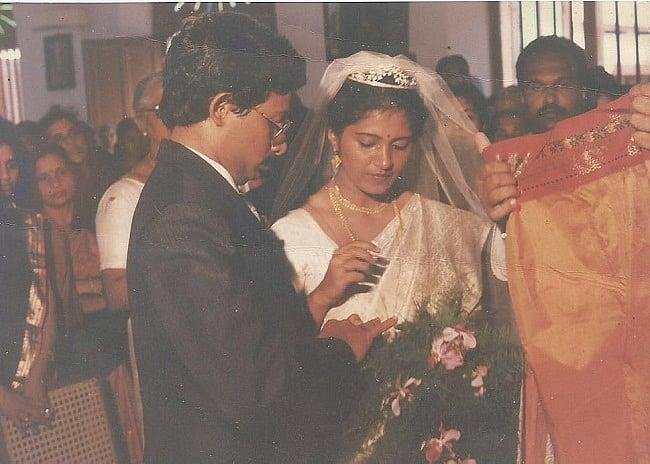
Marriage occupies the most prominent place among the customs and ceremonies of the Knanaya community. Historical records indicate that, until the end of the nineteenth century, a traditional Knanaya wedding (Kettukalyanam) was celebrated over four days and comprised numerous elaborate rituals. Some of the most significant customs are described below.
Endogamy: The Foundational Tradition
According to ancient tradition, members of the Thekkumbhagar (Knanaya) community marry only within their own community. This practice of endogamy has long been regarded as the defining characteristic of Knanaya identity.
Early European writers, including Ros, Gouvea, and Diogo do Couto, observed that this tradition was firmly established even at the time of the Portuguese arrival in India. Likewise, historical sources record the unsuccessful attempts of Archbishop Dom Aleixo de Menezes at the Synod of Diamper (Udayamperoor, 1599) to promote intermarriage between the Northist and Southist Syrian Christians. These efforts met with strong resistance and ultimately failed.
P. U. Lucas, in the introduction to Purathanapattukal (1910), wrote:
“The Thekkumbhagars never permit marriage outside their own lineage. Furthermore, if anyone violates the ancestral custom by marrying outside the community, that person is excluded from the lineage.”
Traditionally, only those born to both Knanaya parents are regarded as members of the community. Consequently, marriage between two Knanaya individuals has been considered essential for preserving the community’s identity, traditions, and cultural heritage. For nearly sixteen centuries, this practice of endogamy has functioned as the principal foundation for maintaining the continuity of the Knanaya community.
Importantly, this tradition is understood not as a rule imposed upon others but as a voluntary commitment embraced by the community itself for its own preservation. While some critics view endogamy through the lens of modern individualism as restrictive or incompatible with personal freedom, members of the Knanaya community argue that the freedom to marry within one’s own community deserves the same recognition as the freedom to marry outside it.
Accordingly, individuals who choose to preserve the community’s traditions by marrying within it continue to enjoy full membership, while those who voluntarily marry outside the community exercise their personal choice with the understanding that they relinquish their traditional communal identity. From the community’s perspective, this approach represents a balance between individual freedom and the preservation of a distinctive cultural and religious heritage.
Bride-Viewing and Betrothal
Traditionally, the groom’s family first visits the bride’s home to formally see the prospective bride (Pennu Kaanal). This is followed by the formal betrothal (Urappir) at the groom’s residence.
Since many marriages in earlier centuries were arranged when the bride and groom were still very young, parents and senior relatives generally made all matrimonial decisions. In many cases, the bride and groom first saw one another only during the engagement ceremony or at the wedding itself.
Erecting the Wedding Pavilion (Pandal)
Until recent decades, wedding celebrations were held beneath a specially constructed pavilion (pandal) in the courtyard of the family home.
Among the Knanaya, the ceremonial installation of the first post of the pavilion is performed by the maternal uncle (Ammachan) of the bride and groom. Traditionally, the first post is cut from a latex-bearing tree such as the jackfruit tree, symbolizing prosperity, fertility, and divine blessing.
Ancient Knanaya folk songs describe the wedding pavilion in considerable detail, referring to it as the Karppura Pandal (“Camphor Pavilion”), a poetic expression denoting beauty, splendour, and auspiciousness.
Othukalyanam (Engagement Ceremony)
The Knanaya engagement ceremony, known as Othukalyanam, is also called Arakkalyanam (“half-marriage”), since it traditionally marked the formal and irrevocable commitment preceding the wedding ceremony.
P. U. Lucas observed that, because marriages were arranged by elders and the consent of the bride and groom was not customarily sought beforehand, the engagement held in the church was often the first occasion on which the couple met each other.
Among Knanaya Catholics, the engagement takes place before the parish priest, where the paternal uncles (Perappanmar) of both families formally clasp hands and pledge the marriage on behalf of their respective families. Among the Knanaya Jacobites, the bride and groom traditionally do not attend this ceremony; instead, their paternal uncles complete the engagement before the priest.
Although marriage unites two individuals, the engagement ceremony also symbolizes the union of two families. The family elders publicly promise before the Church that the marriage will be solemnized on the agreed date according to established customs.
Following the engagement, a festive meal is served beneath the wedding pavilion. As a mark of honour, the bride’s maternal uncle ceremonially pours water over the groom’s maternal uncle’s hands before the meal begins. A specially prepared chicken leg is served first, and it is divided among all those seated, symbolizing unity, fellowship, and shared blessings.
Folding the Banana Leaf
One distinctive Knanaya custom is the folding of the left edge of the banana leaf downward before beginning a ceremonial meal. According to tradition, this practice commemorates one of the “Seventy-Two and a Half Privileges” granted to Knai Thoma.
The Panan Pattu recounts the traditional legend behind this custom. In ancient times, the privilege of dining on two banana leaves was reserved exclusively for kings, nobles, and Brahmins. The king had also granted this honour to Knai Thoma. However, during the king’s absence, certain jealous individuals denied him this privilege. Displaying remarkable wisdom, Knai Thoma folded a single banana leaf into two and dined upon it.
When the king learned what had happened, he permanently granted Knai Thoma and his descendants the right to fold the banana leaf while eating. Thus, the practice serves both as a reminder of the royal privileges traditionally associated with the Knanaya community and as a lasting memorial to the wisdom and resourcefulness of Knai Thoma, the community’s revered founder.
Presentation of the Strīdhanam (Dowry)
Following the engagement feast (Othukalyanam Sadhya), a ceremonial presentation of the Strīdhanam (dowry or family inheritance) takes place. A woven mat is spread on the floor, a traditional oil lamp is lit, and all those present join in prayer. Thereafter, in the presence of the assembled relatives and witnesses, the Strīdhanam or family wealth that had been agreed upon earlier is formally transferred between the paternal uncles representing the bride’s and groom’s families.
This custom should not be interpreted according to the modern understanding of the dowry system. Rather, it must be viewed within the social and economic context that existed centuries ago. Immovable property was generally inherited by sons in order to prevent ancestral land from being fragmented or passing into the possession of other families. According to Knanaya tradition, a woman became a member of her husband’s household after marriage. Moreover, the division of family property usually took place only during the old age of the family head or after his death.
Had daughters also received portions of the ancestral landed property, the family estate would have been divided into increasingly smaller holdings. Furthermore, a son-in-law living elsewhere might eventually sell the inherited land outside the family, resulting in the loss of ancestral property. Consequently, an unwritten customary principle developed within the Thekkumbhagar community: sons inherited immovable property, whereas daughters received movable property.
Accordingly, either at the time of marriage or shortly thereafter, the bride’s family presented movable assets such as gold and silver ornaments, money, household utensils, and other domestic articles. These gifts provided the newly established household with its initial financial resources and essential domestic equipment. At the same time, the groom’s family ensured the couple’s long-term economic security by providing access to the family’s ancestral immovable property.
Within its original historical setting, therefore, Strīdhanam was not conceived as a commercial transaction or a compulsory payment demanded by the groom’s family. Rather, it functioned as a traditional system of inheritance through which daughters received their rightful share of the family’s wealth in the form of movable property, while the integrity and continuity of the ancestral estate were preserved for future generations.
Antham Chārthu / Chantham Chārthu
Antham Chārthu is the principal pre-wedding ceremony conducted on the eve of the wedding at the bridegroom’s residence in the Thekkumbhagar (Knanaya) community. In Malayalam, the word antham, as used in the expression “anthavum kunthavum illa” (“without understanding or common sense”), denotes wisdom, discernment, or maturity. The ceremony may therefore be understood as the community’s formal recognition that the bridegroom has attained the physical, mental, and emotional maturity necessary for married life. It also symbolizes his readiness to assume the responsibilities of a husband and future father. Since marriages in earlier times often took place at a very young age, the name Antham Chārthu itself reflects the ceremony’s association with the attainment of maturity. Comparable rites of passage marking the transition into adulthood are found in many cultures throughout the world.
The ceremony is also known as Chantham Chārthu. This alternative name derives from the traditional practice whereby the bridegroom received his first ceremonial shave on the night before the wedding. A village barber anointed him with oil, shaved him, and prepared him for marriage, giving rise to the name Chantham Chārthu, literally meaning “adorning with beauty.” Like the Mailānchi Iṭīl (Henna Ceremony) performed at the bride’s home, these two names complement one another by emphasizing both inner maturity (Antham) and outward adornment (Chantham).
The ceremony is held beneath a specially erected wedding pavilion under the supervision of the family elders. It begins with evening prayers offered before a lighted traditional oil lamp. Under the direction of the bridegroom’s sister, a mat is spread, upon which a ceremonial seat (Pāvāda) is prepared by placing a white cloth over a black woollen blanket. The bridegroom is then seated upon this ceremonial seat.
The village barber enters the pavilion, approaches the bridegroom, and formally asks the assembled gathering three times:
“Before the seventeen communities, I ask your permission: may I perform the Antham Chārthu for the bridegroom?”
This ceremonial proclamation recalls the traditional privileges believed to have been granted to Knai Thoma by the Chera ruler Cheraman Perumal, according to which the Thekkumbhagar community enjoyed precedence over seventeen other castes or social groups. The first two requests are met with the customary response that the question has not been heard, while permission is granted only after the third request. Repeating important questions three times is a characteristic feature of Knanaya ceremonial tradition and also reflects the liturgical practice of the Syriac Christian tradition, in which triple repetition carries symbolic significance. Originally, this practice may have ensured that every member of the gathering had heard and acknowledged the formal request.
Having received the community’s approval, the barber cuts the bridegroom’s hair, shaves him, and anoints his head with oil. During this ritual, the traditional Antham Chārthu Pāttu (Song of Antham Chārthu) is sung. The song recounts the principal ceremonies associated with the Knanaya marriage tradition. Upon completion of the grooming, the bridegroom’s brother-in-law (his sister’s husband) escorts him for the ceremonial bath, thereby bringing the Antham Chārthu ceremony to its conclusion. Other traditional songs are also sung on the occasion.
As part of the customary remuneration, the white cloth used in preparing the ceremonial seat belongs to the barber, who is also presented with additional gifts in recognition of his services.
Mailānchi Iṭīl (The Henna Ceremony)
Mailānchi Iṭīl (the Henna Ceremony) is the principal pre-wedding ritual conducted on the evening before the wedding at the bride’s residence. Following the opening prayers, the bride is seated on the ceremonial Pāvāda beneath the wedding pavilion by her eldest sister. Henna leaves are freshly ground into a paste, which is then applied to the bride’s palms, feet, and fingernails and toenails by her paternal grandaunt (Valiyamma) and her paternal aunts. During the ceremony, the traditional Mailānchi Pāttu (Henna Song) is sung.
The application of henna is a widespread custom practiced by many communities both within and outside Kerala, either in connection with marriage or on other festive occasions. In most traditions, henna is primarily regarded as a cosmetic adornment that enhances physical beauty. Among the Thekkumbhagar (Knanaya) Syrian Christians, however, the Mailānchi Iṭīl ceremony possesses a distinctive spiritual significance. This uniqueness lies in the symbolic meaning conveyed through the Mailānchi Pāttu, which emphasizes inner spiritual beauty rather than merely external ornamentation.
The ceremony symbolically represents the purification of the human person through the removal of the causes of sin, thereby signifying the quest for inner holiness. According to the biblical account, sin entered the world through the disobedience of the first human beings, Adam and Eve (Genesis 3). Consequently, the hands, feet, and body—understood in the song as the instruments through which sin was committed and by which humanity became defiled—are ceremonially anointed with henna while the verses of the Mailānchi Pāttu are sung, symbolizing spiritual cleansing and renewal.
The song expresses this symbolism as follows:
Because the hand plucked the forbidden fruit,
Henna is applied upon the palm.
Because the feet walked to partake of the fruit,
Henna is applied upon the toenails.
Because the body returned to the dust,
Henna is applied upon the hands.
(Mailānchi Pāttu)
The song further recalls that, as a consequence of sin, Adam and Eve were overcome by fear and shame and hid themselves among the trees of the garden. Their shame has become the inheritance of all humanity. Thus, covering oneself with green leaves is presented symbolically as humanity’s first attempt to conceal shame:
Because they hid among the trees,
Even today their children continue to hide.
(Mailānchi Pāttu)
Thus, within the Knanaya tradition, the Mailānchi Iṭīl ceremony transcends the simple application of henna as a cosmetic practice. It serves as a profound theological symbol of repentance, purification, and moral renewal, preparing the bride not only outwardly for marriage but also inwardly for the sacred vocation of Christian married life.
Ichappādu (Ceremonial Feeding)
After the ceremonial bath, the bride and bridegroom return to the wedding pavilion at their respective homes, where the ritual known as Ichappādu is performed. For this occasion, the sisters of the bride and groom bring to the pavilion a specially prepared dish of Venpāchōru (white rice delicacy) and sugar, together with a ceremonial bowl (Kiṇḍi) and spittoon (Kolāmbi) used for cleansing the mouth.
P. M. John Pullappally suggests that Venpāchōru is the Kerala adaptation of a traditional ceremonial food that the Knanaya ancestors had brought from their original homeland. Its exclusive preparation for this ritual highlights its cultural and ceremonial significance within the community.
Before the ceremony begins, the paternal uncles (Perappanmar), wearing the traditional Knanaya headgear known as “Njettum Vālum”, formally seek the permission of the assembled community by asking three times:
“May we offer the Ichappādu to the bridegroom (or bride)?”
Only after receiving the community’s approval do they proceed with the ritual. Using the ceremonial Kiṇḍi and Kolāmbi, they first cleanse the mouth of the bride or bridegroom. They then mix the Venpāchōru with sugar, roll it into small morsels, and ceremonially place it into the mouth three times. During this act, the elder supports his right elbow with his left hand, a gesture of reverence and ceremonial decorum that characterizes many traditional Knanaya rituals.
After the ceremonial feeding, the mouth is once again cleansed using the Kiṇḍi and Kolāmbi. The privilege of performing Ichappādu is reserved exclusively for one or three senior paternal elders, symbolizing their role as representatives of the family lineage and their responsibility for blessing and formally preparing the bride and bridegroom for married life.
More than a simple act of feeding, Ichappādu signifies the affectionate blessing, acceptance, and ceremonial commissioning of the couple by their paternal elders. It expresses the continuity of family tradition, the transmission of ancestral blessings, and the community’s prayer that the newly married couple may enjoy a prosperous, harmonious, and fruitful married life.
The Traditional Njettum Vālum Headgear
One of the distinctive cultural symbols of the Knanaya community is the traditional headgear known as the “Njettum Vālum” (Headgear with a Crest and Tail). It is fashioned by folding a kasavu cloth (a traditional Kerala cloth with a gold border) or a cotton towel (thorthu) and tying it around the head in such a way that both ends project upward, creating a characteristic crest-like appearance. This unique style of headgear is regarded as exclusive to the Knanaya community and serves as a visible marker of its cultural identity.
The Njettum Vālum headgear was worn not only during ceremonial occasions but also in everyday communal life. It was commonly seen when groups gathered to sing traditional songs, while working together in agricultural fields, and during other community activities. Its widespread use reflected a strong sense of shared identity and cultural belonging among the Knanaya people.
In ceremonial contexts, however, the headgear assumed special significance. During formal rituals, particularly when ceremonial questions were posed to the assembled community seeking their approval or consent, the officiating elders were required to wear the Njettum Vālum headgear. In this setting, it functioned as a symbol of authority, dignity, and representation, signifying that the speaker acted not merely as an individual but as the recognized representative of the family and the community.
Thus, the Njettum Vālum headgear is more than a traditional form of dress. It is an enduring cultural emblem of Knanaya identity, symbolizing honour, communal leadership, continuity of tradition, and the preservation of the community’s distinctive heritage across generations.
Bringing the Thāli
The ceremonial presentation of the Thāli (marriage pendant) takes place at the bridegroom’s residence before the wedding. The goldsmith (Thattan), who has crafted the Thāli, formally brings it to the family. A ceremonial tray is prepared by spreading rice upon it, and the Thāli is reverently placed on a betel leaf laid over the rice. The tray is then presented by the goldsmith to the bridegroom’s family. The bridegroom’s sister ceremonially receives the Thāli and, in return, presents the goldsmith with an appropriate honorarium in recognition of his craftsmanship and service.
The Knanaya Thāli is distinguished by its unique design. It is fashioned in the shape of a long, narrow banyan leaf (ālila), a form that differs from the marriage pendants used by many other Christian communities in Kerala. At its centre is a cross composed of twenty-one small projections or buds (arimpukal). The number twenty-one, being the product of three and seven, is traditionally interpreted as symbolizing the Holy Trinity (three) and spiritual perfection or fullness (seven). Thus, the design of the Thāli reflects both theological symbolism and the community’s Christian faith.
On the wedding day, the Thāli is threaded onto a specially prepared cord rather than a chain. This cord is made by the bridegroom’s sister, who carefully removes seven threads from the Manthrakodi (the ceremonial bridal sari blessed for the wedding), folds them into three strands, and twists them together to form a single cord. The Thāli is then strung onto this hand-twisted cord and is tied around the bride’s neck during the marriage ceremony.
The preparation of the Thāli and its cord is therefore more than a practical arrangement; it is a ritual rich in symbolism. The participation of the bridegroom’s sister underscores the important role of the family in the marriage ceremony, while the sacred symbolism embodied in the Thāli and its cord reflects the Knanaya community’s integration of Christian faith, family tradition, and cultural heritage.
Traditional Performing Arts
Wedding celebrations in the Knanaya community were traditionally enriched by a variety of performing arts that reflected the community’s rich cultural heritage. Members of the bride’s and groom’s families, as well as groups of men and women, participated in friendly performances and cultural exchanges, adding a festive and communal dimension to the celebrations.
Among the principal performances were the singing of ancient Knanaya folk songs, the recitation of the Pāṇan Pāttu (Ballad of the Pāṇan), and the presentation of traditional art forms such as Margam Kali, Vattakkali, and Parichamuttukali. These performances were not merely forms of entertainment but also served as vehicles for preserving the community’s history, religious faith, social values, and collective memory. Through song, dance, and dramatic expression, they transmitted the traditions of the Knanaya people from one generation to the next.
The participation of both the bride’s and groom’s families fostered fellowship, strengthened kinship bonds, and transformed the wedding into a celebration of the entire community rather than simply the union of two individuals.
Each of these traditional performing arts possesses a rich historical and cultural background. A detailed discussion of their origins, development, symbolism, and performance traditions will be presented in a subsequent chapter.
The ceremonies and rituals observed on the actual wedding day (Kettukalyanam) will be described in the following section.