In the report on Kerala written by Mar Roz in 1604, the name of the king who granted the Knānāya copper plates is recorded not as Cheraman Perumal, but as Kseram Perumal. Interestingly, the Pāṇan Pāṭṭu itself begins with the invocation, “Cherām Perumal Thampurān…” Although the name is commonly known today as Cheraman Perumal, the Pāṇan bard sings it as Cherām. In Tamil (the ancient Dravidian language), the sounds cha and sa are often used interchangeably. For example, Chandran becomes Santiran, and Chandanam becomes Santanam. From this, it may reasonably be inferred that traditional songs such as the Pāṇan Pāṭṭu helped Bishop Mar Roz determine the king’s name. The title Cheraman Perumal does not refer to the personal name of an individual but rather to a royal title meaning “the Great One of the Chera Kingdom.”
The Cheraman Perumal portrayed in the Pāṇan Pāṭṭu deserves particular attention. He entrusted Knānāya Thomas with the mission of bringing back the Nāṅkuṭi families who had left the country, and, upon the successful completion of that mission, rewarded him with royal honours and privileges. The king recognized the importance of foreign trade in the economic and cultural development of his kingdom and encouraged overseas merchants by granting them special privileges. As part of creating the necessary infrastructure for the smooth conduct of international trade, he also initiated measures to bring back those who had migrated elsewhere.
Recognizing the abilities and potential of those residing within his realm, including foreigners, and utilizing their talents for the development of his kingdom, he appointed Knānāya Thomas to lead the mission of bringing back the Nāṅkuṭi families. His policy of rewarding merit is evident in the royal honours he bestowed upon those who served the kingdom faithfully. According to tradition, he even demonstrated remarkable humility and self-sacrifice by presenting to Knānāya Thomas what could have been his own golden crown.
Other historical sources also attribute to Cheraman Perumal the title Kocherakon, conferred upon Knānāya Thomas, as well as the grants of tax-free lands for the construction of churches and houses. Equally noteworthy is the king’s openness and hospitality in accepting a person of another faith, allowing him to live according to his own religious traditions, and even recognizing the patriarch of that faith as a witness in the copper plate charter. In doing so, he served as a bridge of coexistence among different religious communities.
For all these reasons, the Knānāya community in Kerala owes a profound debt of gratitude to the Chera king who established his capital on the banks of the Periyār River. It is therefore no coincidence that the royal title of that dynasty came to be Perumāl, literally meaning “the Great One.”
Royal Honours
The honours and privileges that Cheraman Perumal conferred upon the foreign merchant Knāyithoma (Knānāya Thomas) must be reinterpreted within their broader historical, economic, and social context. These grants reflect a vision in which the expansion of overseas trade was regarded not merely as a means of economic prosperity but also as the foundation for the peaceful coexistence of diverse communities. It is also noteworthy that the seventy-two privileges and tax-exempt land grants were not bestowed exclusively upon Knāyithoma. Similar rights were later granted to the Persian Christian community of Mar Sabor and Mar Proth through the Tharisapalli Copper Plates (A.D. 849), and to the Jewish community under Joseph Rabban through the Jewish Copper Plates (c. A.D. 1000). In every instance, these privileges were extended specifically to foreign mercantile communities in order to encourage and strengthen international trade.
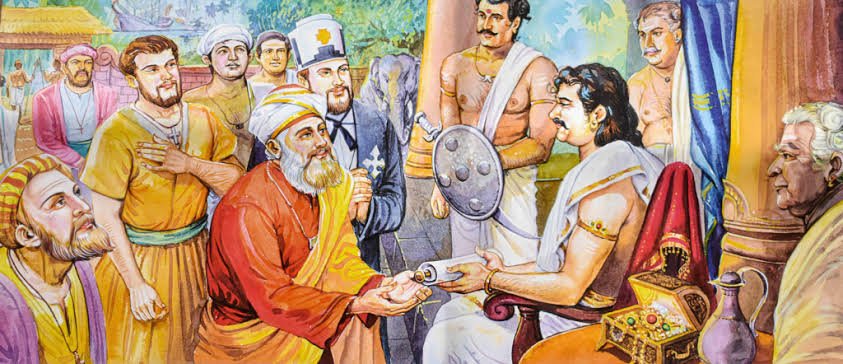
The Pāṇan Pāṭṭu recounts that Cheraman Perumal had these royal honours engraved on copper plates and presented them to Knāyithoma. When Knāyithoma appeared before the king wearing the royal crown presented to him by the Nāṅkuṭi Parishes, the king addressed him in these words:
Come near, come near, O Thommacha;
The golden crown itself belongs to you.
But the crown alone is not enough, O Thommachan;
You must also receive the honours that accompany the crown.
According to the tradition preserved in the Pāṇan Pāṭṭu, the king granted seventy-two and a half royal honours to Knāyithoma as a reward for successfully bringing back the Nāṅkuṭi Parishes.
In the version of the Pāṇan Pāṭṭu published by P. J. Thomas, only seventeen honours are listed. However, the recension attributed to Nārāyaṇa Pāṇan of Mulanthuruthy, recorded by Dr. Velliyan, preserves the complete list of seventy-two honours, together with the additional half-honour. These include the crest ornament (Uccippūvu), forehead ornament (Neṭṭippaṭṭam), daytime ceremonial lamp, royal ceremonial cloth (Pāvāḍa), Nērkālāñci, flower rings on all ten fingers, left-turning silver conch, right-turning golden conch, festoons, bracelets, armlets, ceremonial staff (Aṁśavaṭi), conical cap, necklace, medallion, rosary, clockwise ceremonial flame, staff, palanquin, canopy, drums, gun salutes, acclamations, decorations, green umbrella, coral umbrella, jeweled umbrella, pearl umbrella, flagstaff, flag-hoisting, ceremonial swing, boat, golden palanquin, palanquin litter, elephant procession, howdah, heroic drum, seventeen musical instruments without the conch, the privilege of placing a cut teak log in the river, Pāccil tree, Veriku, tiger, pig in the well, jackfruit, plantain cluster, Ammulam, Mummulam, Chilli, red horn, granary, bathhouse, gateway, theatre hall, golden crown, and Thoppippāḷ, together with the half-honour of folding one’s plantain leaf after meals.
By contrast, the recension attributed to Rāman Pāṇan of Piravom records only fifty-four honours. These include the crest ornament, forehead ornament, daytime lamp, Pāvāḍa, bracelets, armlets, conical cap, ceremonial staff, bracelet, hero’s chain, arm guard, shoulder ornaments, placing timber in the river, Anjili, jack tree, teak, gourd, pig in the well, Veriku, tiger, jackfruit, plantain, city festoons, standing lamp, staff lamp, Mandāram, bell lamp, fireworks, military honours, Chinese fireworks, green umbrella, coral umbrella, pearl umbrella, jeweled umbrella, flag-hoisting, drumming, gun salutes, acclamations, decorations, staff, palanquin, carpet, Nālukettu (traditional courtyard house), theatre hall, festival pavilion, elephant riding, riding in a howdah, horse riding, palanquin, ceremonial boat, golden crown, and Thoppippāḷ.
The differences between these recensions illustrate the evolution of the oral tradition over time. While the number and sequence of the honours vary among versions, they consistently preserve the central memory that Knāyithoma was invested with exceptional royal privileges by the Chera king in recognition of his distinguished service to the kingdom.
The “Half-Honour” among the Seventy-Two and a Half Privileges
The Pāṇan Pāṭṭu declares, “The folding of the leaf shall be regarded as the half-honour, O Thommacha.” This expression carries a significance far greater than its literal meaning. The term “half-honour” (arappadavi) need not be understood merely as denoting “half” in the numerical sense. Rather, it is more plausibly interpreted as a contracted form of “aracha-padavī”—that is, a royal honour or a privilege conferred by the king. Similar linguistic contractions are found elsewhere in Malayalam: aramanā (palace) derives from arachan-manā (“the king’s residence”); arayāl (the sacred fig tree) literally means “the king among trees”; arayannam (“royal swan”) signifies “the king among birds”; and arakkavi, used of Punam Nambudiri, denotes the “royal poet.” These examples suggest that arappadavi may likewise be understood as a royal distinction rather than simply a “half privilege.”
This interpretation is further supported by lines in the ancient songs such as “the honours bestowed by the king of kings” (aracharkkarachan koduththoru padavikal) and “the nine royal princes assembled together” (rājamakkal eṇṇonpathum kūḍippukinth). Even the alternate name of the Southists, Añcharappallikkār, may perhaps be interpreted along similar linguistic lines.
A traditional legend explains why folding the plantain leaf while eating came to be regarded as a royal honour granted by Cheraman Perumal to Knāyithoma. Certain nobles at court were jealous of the high esteem in which the king held Knāyithoma. On one occasion, during the king’s absence, a banquet was held in the palace. Intending to humiliate him, the nobles served Knāyithoma on only one plantain leaf, whereas distinguished guests were customarily served on two leaves, a mark of honour and prestige.
Knāyithoma neither accepted the slight in silence nor protested in anger. Instead, displaying remarkable intelligence and diplomatic wisdom, he simply folded the single leaf into two and ate his meal upon it. The merchant’s elegant solution conveyed a profound lesson. It surpassed even the celebrated paradox of the “Sultan of Beypore” that “one and one make one”; for the merchant’s own equation was that half of one becomes two. Combining restraint with practical wisdom, he transformed a potential insult into an affirmation of dignity. By doing so, he resolved what might otherwise have escalated into a dispute over status or even communal conflict, thereby strengthening both his personal authority and the standing of his community.
Knāyithoma thus bequeathed to the Knānāya community a lasting heritage: unwavering commitment to fundamental principles without sacrificing the practical wisdom necessary for harmonious social coexistence. It is the heritage of choosing the golden mean—firmness without rigidity, prudence without surrender.
When Cheraman Perumal learned of Knāyithoma’s response, tradition holds that he elevated the act into a royal privilege, formally authorizing Knāyithoma and his descendants to dine with the left side of the plantain leaf folded. According to tradition, this became a unique royal distinction, one granted to no other community. Even today, members of the Knānāya community traditionally eat from a plantain leaf folded on the left side in remembrance of this privilege.
The Knāyithoma Copper Plate Charter
The royal honours bestowed by Cheraman Perumal upon Knāyithoma constitute the foundation of many Knānāya customs, traditions, ceremonial practices, and ancient songs. These privileges enabled the foreign merchant Knāyithoma and his followers to settle permanently in Kerala, build homes and churches, practise the Christian faith freely, engage honourably in trade, prosper economically, and live with social distinction in peaceful coexistence with other communities.
The Pāṇan Pāṭṭu describes how Cheraman Perumal had these royal privileges engraved upon copper plates and presented them to Knāyithoma:
With the Sun and the Moon,
And Saint Thomas the Apostle,
The three as witnesses,
He wrote them upon the copper plates.
Have them copied upon black stone,
At the northern gateway of Kodungallur,
Cover it over with stone.
The original copper plate charter is no longer extant. Historical records indicate that it was lost toward the close of the sixteenth century. Nevertheless, valuable sixteenth-century documents and translations prepared by the Chaldean-Syriac bishops who preserved the charter, as well as by the Portuguese who later examined it, have survived to the present day. The verses of the Pāṇan Pāṭṭu likewise reinforce the existence of this tradition.
Whether or not the Pāṇan’s claim that a stone copy of the charter was placed beneath the northern entrance of the Kodungallur temple is historically accurate, the tradition itself is significant. It reflects the idea that the charter was considered worthy of being permanently inscribed in stone and preserved within the temple precincts. Such a conception suggests not only the perceived authenticity and enduring importance of the charter but also an aspiration to ensure its perpetual protection and to symbolize an atmosphere of religious harmony and mutual respect.
Knāyithoma: A Christian Believer and Evangelizer
The Pāṇan Pāṭṭu does not describe the missionary purpose of the migration led by Knāyithoma, nor does it mention Cheraman Perumal’s grant of tax-free land for the construction of a church, or the subsequent building of churches and houses. These details are known to us from other ancient songs and from the writings of foreign travelers and chroniclers. Nevertheless, a single word in the Pāṇan Pāṭṭu itself stands as a powerful testimony to Knāyithoma’s Christian faith.
While narrating how Cheraman Perumal inscribed the royal honours and privileges on the copper plate charter, the Pāṇan includes one striking name among the witnesses. In addition to the customary invocation of the Sun and the Moon as witnesses—an established feature of royal charters—the song also names Saint Thomas the Apostle (Mar Thoma Sleeha) as a witness. This is highly significant.
It is unlikely that Cheraman Perumal, a Hindu ruler, would on his own have invoked Saint Thomas as a witness when the charter was issued. Nor is it probable that the Pāṇan bards independently inserted the Apostle’s name into the song. The most plausible explanation is that the inclusion of Saint Thomas reflects the direct influence or request of Knāyithoma himself.
For Knāyithoma, who belonged to the Church of Seleucia-Ctesiphon and had received the Christian faith through the apostolic succession that traced from Saint Thomas the Apostle, through Mar Addai, to Mar Mari, Saint Thomas was not only the father of his faith but also the inspiration behind his own name. It was this profound devotion to the Apostle that most likely inspired Knāyithoma to build, at Kodungallur, the first Christian church in India dedicated to Saint Thomas.
Since the original copper plate charter has not survived, it cannot be determined with certainty whether the name of Saint Thomas actually appeared among its witnesses. None of the surviving translations of the charter records the Apostle’s name. Even if the original charter did not include Saint Thomas as a witness, the appearance of his name in the Pāṇan Pāṭṭu remains significant.
If the Apostle’s name was absent from the original charter, it is reasonable to suppose that it was the Knānāya community itself that encouraged the Pāṇan bards to incorporate it into the song. Such an addition would have expressed their devotion to Saint Thomas, the namesake of their migration leader and the founder of their Mother Church in India. The enduring popularity of ancient Knānāya devotional traditions such as the Mārgam Kali songs and the Mārthoma Pāṭṭu may likewise be seen as a continuation of this deep-rooted reverence for the Apostle.