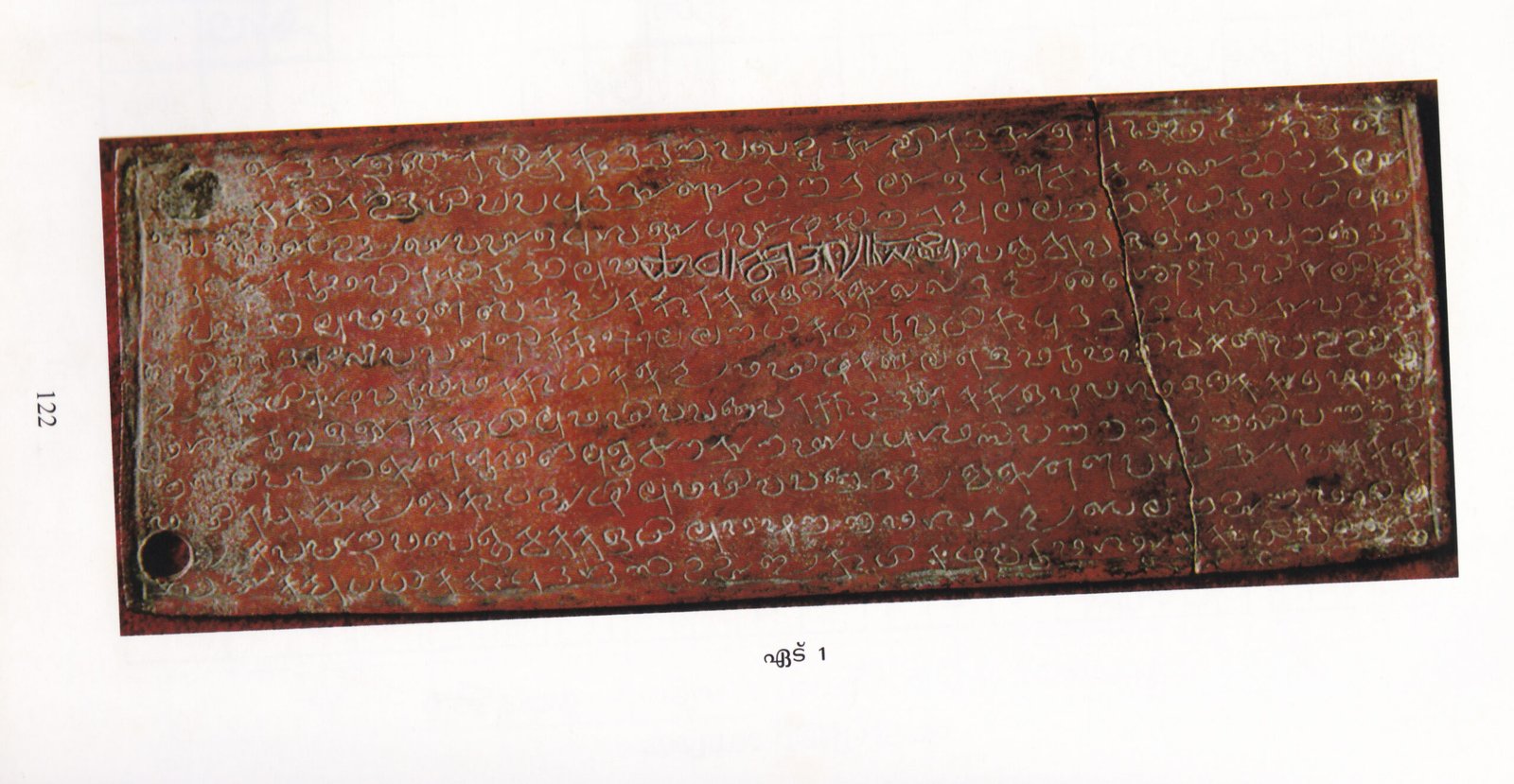
This study is an attempt to examine the relationship between the Knanaya Thomas (Knāyithomman) Copper Plates and the Tharisapalli Copper Plates. Earlier, I had written that:
“The historical connection between the Knanaya community, who lived in Kodungallur as descendants of the Syrian Christian merchants who migrated from Persia, and the Syrian Christians who lived in Kollam with Tharisapalli as their centre, together with the fact that the summary of the Knāyithomman Copper Plates appears to have been incorporated into the Tharisapalli Copper Plates—as evidenced by its two surviving copies—and several other factors, prompted an investigation into the relationship between these two inscriptions.”
The purpose of this article, as well as the next, is to explain what those “other factors” are. More specifically, this article argues that the fifth plate, which is currently believed to be part of the Tharisapalli Copper Plates, is in fact not a part of that charter. Since the expression “the fifth plate of the Tharisapalli inscription” does not reflect the central argument of this study, I shall hereafter refer to this plate—which contains only the names of witnesses—as the Witness Plate.
This article presents the evidence suggesting that the Witness Plate may instead have belonged to the Knāyithomman Copper Plates. Since the Tharisapalli charter repeatedly employs the phrase “written and granted on a copper charter” (chembu-pathiram, i.e., copper plate), I have used the equivalent expression “Tharisapalli Copper Charter” in the title rather than the more commonly used term Tharisapalli Copper Plates.
The Plates of the Tharisapalli Charter
Although it is generally accepted that the Tharisapalli Copper Plates consist of five plates, some scholars have questioned whether the fifth plate—written in Kufic Arabic, Sasanian Pahlavi, and Hebrew scripts—actually belongs to the Tharisapalli charter. Among those who hold this view, albeit for different reasons, are Dr. Kanam Sankara Pillai and Dr. István Perczel.
Dr. Kanam, who considers the Tharisapalli Copper Plates to be identical with the Vellala Copper Plates, excludes the Witness Plate from the charter on the basis of Duperron’s French translation. Dr. István Perczel, on the other hand, believes that the Knāyithomman Copper Plates constitute a continuation of the Tharisapalli charter. Consequently, he treats both as a single inscription and identifies the Witness Plate as belonging to the Knāyithomman Copper Plates. To the best of my knowledge, Perczel is presently the only scholar to have suggested that this plate may belong to the Knāyithomman charter.
The hypothesis advanced in this study differs from the conclusions reached by distinguished scholars such as Rev. Hermann Gundert, T. A. Gopinatha Rao, Elamkulam P. N. Kunjan Pillai, M. G. S. Narayanan, M. R. Raghava Varier, and Fr. Kollaparambil. I therefore present it with considerable humility, yet with firm conviction. My conclusion arises from a comparative analysis of the similarities and differences among the plates themselves.
At first glance, the plates appear closely related: they are all engraved on copper, are approximately similar in size, and since their rediscovery in 1806 have consistently been regarded by scholars as components of the Tharisapalli charter. These factors have naturally encouraged their treatment as parts of a single document.
However, if we set aside, for the moment, the internal differences among the first four plates and consider them collectively as one document, while examining the Witness Plate separately, a different picture emerges. When these two groups are compared, the evidence reveals not so much similarity and continuity as significant dissimilarity and lack of direct relationship.
Differences Between the Witness Plate and the Other Plates
The Witness Plate differs from the other plates in several respects, including script, language, writing style, and content.
1. Script:
The principal script used in the first four plates is Vattezhuthu, with a limited number of Grantha characters appearing at certain places. In contrast, the Witness Plate is written exclusively in Semitic scripts—Kufic Arabic, Sasanian Pahlavi, and Hebrew.
2. Language:
The language of the first four plates is Old Malayalam. The Witness Plate, however, is written in Arabic and Persian. Even the section inscribed in Hebrew characters is composed in the Persian language.
3. Writing Format:
Although all five copper plates are rectangular in shape, the first four plates were engraved while held horizontally, whereas the Witness Plate was engraved in a vertical orientation. Correspondingly, the first four plates, employing Indian scripts, are written from left to right, while the Witness Plate follows the Semitic convention of writing from right to left.
4. Content:
The substantive text of the Tharisapalli charter is contained in the first four plates. The Witness Plate, by contrast, consists solely of the names of witnesses, accompanied by expressions equivalent to, “I too am a witness to this.” Beyond suggesting that it may have served as the witness plate of some copper-plate charter, it contains no feature that directly connects it with the preceding plates as a continuation of the Tharisapalli charter.
Another noteworthy feature concerns an inscription in an as-yet undeciphered script, which appears to represent either a signature or a form of attestation. This identical inscription is found on Plates Two and Three, which appear to be of considerable antiquity, as well as on Plate One, which may itself be a copy. (It has been marked in the photographs of the first three plates.) Surprisingly, however, this inscription is absent from the Witness Plate, despite the fact that it appears to be the oldest among the five surviving plates. The absence of this inscription from the Witness Plate is a matter deserving careful consideration.
If one were to regard the Witness Plate as the original plate of the Tharisapalli charter, while assuming that the remaining four plates were later copies made from the original—and, furthermore, treating the Fourth Plate separately as a comparatively recent copy—one possible explanation is that the inscription occurring on the remaining three plates represents a certification or endorsement indicating that they are faithful copies of the original. This, however, remains no more than a hypothesis.
On the other hand, if the Witness Plate is accepted as an integral part of the Tharisapalli charter, it becomes difficult to explain why this inscription appears only on the first three plates and not on the Witness Plate itself. At present, no more satisfactory explanation seems to be available. It must therefore be acknowledged that the interpretation proposed above is highly hypothetical.
The Fourth Plate: A Later Copy
The absence of this signature or attestation mark on the fourth plate further supports the possibility that it is merely a later copy. Several factors point to this conclusion.
To begin with, the fourth plate appears visibly newer than the others. The plates believed to be copies—the First and Fourth Plates—measure approximately 8.8 × 3.2 inches, whereas the apparently original Plates Two and Three, together with the Witness Plate, are slightly larger, measuring approximately 9.1 × 3.3 inches.
Among the Second, Third, and Fourth Plates, which I have personally examined, the Fourth Plate is noticeably heavier than the Second and Third. It also differs markedly in its layout. The obverse contains only eight lines and the reverse seven lines, with the letters engraved at comparatively wide intervals. By contrast, Plates Two and Three each contain thirteen or fourteen lines on both sides, with the characters closely and compactly engraved.
Additional evidence is provided by the Curzon transcript of the Tharisapalli Copper Plates. At the end of the section entitled “Text of the Fourth Plate,” the Curzon copy incorporates a summary of the Knāyithomman Copper Plates. According to Duperron’s translation, arranged plate by plate, the original Fourth Plate contained not only the text preserved on both sides of the present Fourth Plate and the one-and-a-half witness names, Vēḷkula Sundaran and Vichaiya, but also the remaining fifteen-and-a-half witness names beginning with Nārāyaṇa, together with the summary of the Knāyithomman Copper Plates. Duperron further records that the royal elephant seal was placed between the twelfth and thirteenth witness names.
Significantly, none of the surviving plates bears the elephant seal, which was the official emblem of the Kingdom of Venad. This leads to an important conclusion. The original Fourth Plate, which formed part of the charter, appears to have been lost. Furthermore, if that original plate was copied into two separate plates, the second of those copies—which contained the remaining fifteen-and-a-half witness names, the summary of the Knāyithomman Copper Plates, and the elephant seal—must also have been lost.
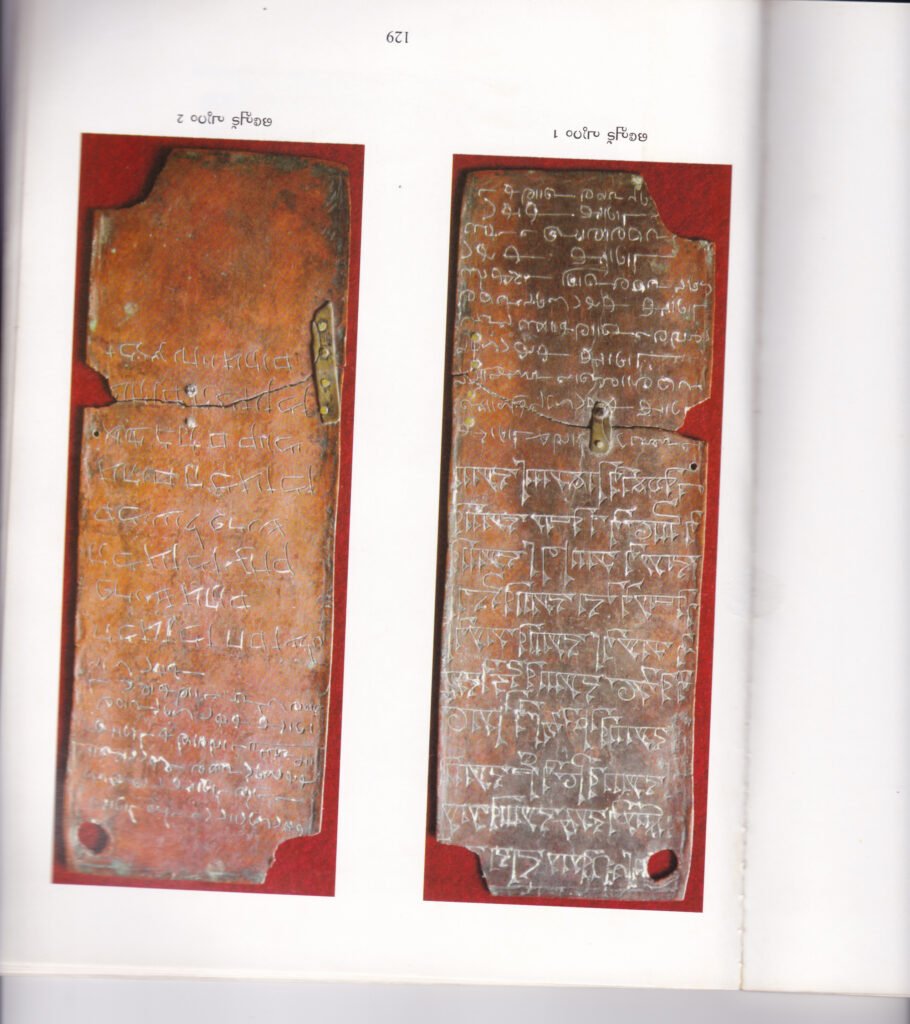
The Position of the Ring Holes in the Tharisapalli Charter
As a continuation of my investigation into the differences among the plates, I examined the position of the holes through which the copper-ring binding passed. (I have not had the opportunity to examine the First Plate or the Witness Plate in person. My observations on these two plates are based on the photographs published in Tharisappalli Pattayam by Dr. M. R. Raghava Varier and Dr. Kesavan Veluthat.)
All the surviving plates have their binding holes on the left side. The obverse of the First Plate is blank, while the reverse, as seen in the published photograph, contains two holes—one near the top and the other near the bottom. Significantly, the upper hole is located in the margin and does not cut through the inscription, whereas the lower hole cuts across the engraved letters. This suggests that the charter had already been inscribed when it was realized that the original hole would not permit the plates to be bound together properly, necessitating the drilling of a second hole lower down.
In Plates Two and Three, which are more likely to represent the original charter, the binding hole is located at the upper part of the obverse and the lower part of the reverse. The Fourth Plate, which also appears to be a later copy, exhibits two holes similar to those of the First Plate. Here again, the holes originally made in the margins—at the lower part of the obverse and the upper part of the reverse—would not have allowed the plate to align correctly with the others. Consequently, new holes appear to have been drilled through the inscription at the upper part of the obverse and the lower part of the reverse in order to facilitate proper binding.
The arrangement of these holes indicates that the plates were intended to be connected by a copper ring in such a way that they would be turned upward while being read. Palm-leaf manuscripts are likewise turned upward or downward rather than sideways. Because the binding hole in palm leaves is usually positioned near the centre, the leaves can be turned either upward or downward. The horizontal rectangular shape of palm leaves naturally lends itself to this mode of reading. When arranged in this manner, the upper edge of one side corresponds to the lower edge of the reverse side.
Modern books, by contrast, are generally read by turning the pages to the right (or to the left in the case of Semitic languages). Since books are normally vertical rectangles, the upper edge remains the same on both sides of every page.
The fifth plate—the Witness Plate—follows this latter pattern. The upper edge remains identical on both sides, unlike the first four plates, where the upper edge of the obverse does not correspond to the upper edge of the reverse. Even though the obverse of the First Plate is blank, the binding hole nevertheless had to be relocated, presumably because the original position did not permit it to be aligned correctly with the remaining plates.
The Witness Plate, which was engraved in a vertical orientation, differs even more fundamentally. Its binding hole is situated at the upper left corner. Since the first four plates were inscribed horizontally while the Witness Plate was inscribed vertically, binding them together on a single copper ring would make their proper storage and reading extremely inconvenient.
Even if one were to place the Witness Plate horizontally in order to align it with the other plates, the hole would then fall at the lower edge of its first side, whereas on all the other plates the corresponding hole is situated at the upper edge of the first side. In this arrangement, the Witness Plate simply cannot be incorporated into the same binding sequence.
The only possible way of overcoming this difficulty would be to reverse the Witness Plate, treating its present reverse side as the first page and its present obverse as the last. In other words, after the eight pages formed by the first four plates, the present second side of the Witness Plate would become the ninth page and its present first side the tenth. Such an arrangement, however, would require an irregular and highly improbable reversal of the normal sequence of plates in an official royal charter. It is therefore difficult to believe that the Witness Plate originally formed part of the same document. The position of the binding hole itself strongly suggests that it belonged to a different charter.
It should be noted that the upper right corner of the Witness Plate is broken away. It is therefore possible that an original binding hole once existed there. If such a hole had indeed been present, it would have aligned satisfactorily with the holes in the other plates. Nevertheless, this possibility raises another question: if the original hole occupied the correct position, why was a second hole drilled on the left side?
One possible answer is that the original hole was lost when the corner broke away, making it necessary to drill a replacement hole on the left. However, this explanation is weakened by the fact that the Third Plate also has a damaged binding hole, yet no additional hole was made there.
I fully recognize that these observations may be difficult to appreciate without physically handling the copper plates themselves. Since direct access to the original plates is not easily available, readers may readily verify the argument by constructing a simple model. By cutting five pieces of cardboard or thick paper to the approximate dimensions of the plates, numbering them from one to five, reproducing the holes in their respective positions, and attempting to bind them together with a string, the difficulty of incorporating the Witness Plate into the sequence becomes immediately apparent.
Secondary Sources and the Provenance of the Tharisapalli Charter
Neither the documentary tradition nor the provenance of the Tharisapalli Copper Plates supports the view that the Witness Plate originally formed part of the Tharisapalli charter. On the contrary, the available evidence appears to suggest otherwise.
According to the sources presently available, the earliest reference to the Tharisapalli Copper Plates occurs in Jornada, published at Coimbra in 1606 by Fr. António de Gouvea. Gouvea records that during Archbishop Dom Aleixo de Menezes’ visitation of the churches of the St. Thomas Christians in 1599, undertaken as part of the efforts to bring the Syrian Christians into conformity with the Latin Church, the Archbishop visited the church at Thevalakkara, Kollam, where he was shown the copper plates.
Gouvea further notes that, because the Knāyithomman Copper Plates had previously been lost after coming into Portuguese possession, the custodians of the Tharisapalli charter required Dom Menezes to swear that he would not remove the plates before allowing him to examine them. He also states that only three plates were shown to the Archbishop and that these were fastened together with an iron ring.
T. K. Joseph has pointed out, in the Kerala Society Papers, that the concluding portion of the Tharisapalli charter was copied onto a stone inscription in the Jacobite church at Kollam in A.D. 1637. If this observation is correct, it is highly probable that the original Fourth Plate had already become considerably damaged about forty years earlier and may even have become detached from the binding ring. If so, it is possible that this plate was not shown to Dom Menezes.
Nevertheless, the Curzon transcript, prepared shortly afterwards (c. 1601–1615), contains the text preserved on the four surviving plates together with the summary of the Knāyithomman Copper Plates. Significantly, however, it does not include the names of the witnesses written either in Malayalam or in the foreign languages.
The Tharisapalli charter is also mentioned in Roteiro Sobre o Trato do Pimenta, written by Francisco da Costa in 1607.
As noted in the previous article, Fr. Diogo Gonçalves, S.J., records in his Historia do Malabar (1615) that, under the direction of Bishop Mar Francis Roz, the charter was read in 1601 by Ittimani Kathanar and Manuel de Sousa, after which Manuel Peres prepared a Portuguese translation.
This work was undertaken against the background of the establishment of the Diocese of Cranganore for the Syrian Christians in 1600, which led to a jurisdictional dispute with the Latin Diocese of Cochin. The central issue concerned the revenues derived from the taxes granted under the Tharisapalli charter: whether they rightfully belonged to the Latin Christians, who possessed the original Tharisapalli church, or to the Syrian Christians, who had established another church a short distance away. To resolve this dispute, the charter was read, copied, and translated into Portuguese. Manuel de Veiga finally ruled that the tax revenues belonged primarily to the Syrian church at Kollam, although a portion was also to be assigned to the local Latin church.
Dr. Kollaparambil has suggested that the Curzon transcript now preserved in the Bibliothèque Nationale de France (MS Syr. 186) originally formed part of the manuscript Historia do Malabar, preserved in the Jesuit Archives in Rome (Goa 58), from which folios 57–60 are now missing. During the period described in that work, the copper plates were reportedly kept in the residence of the Thevalakkara Tarakan.
Duperron’s Zend-Avesta also provides valuable evidence. He notes that, at the request of Florentius of Jesus, Bishop of Verapoly, Fr. Mathai Kathanar, Vicar of Anchikkaymal Church, prepared a Sanskrit (or possibly Malayalam) copy of the charter dated 14 January 1758. Bishop Florentius further informed Duperron, in letters dated 16 and 18 January 1758, that the original copper plates were then preserved in the residence of the Thevalakkara Tarakan.
Fr. Hosten, S.J., observes that despite Duperron’s close relationship with the Dutch authorities—particularly with Mr. Van Rheede’s successor and Council Secretary, who had spent fourteen years studying the antiquities of Kerala—Duperron was unable to locate these copper plates in Fort Cochin.
More significant still is Duperron’s own description of the charter. In Zend-Avesta he explicitly states that the Tharisapalli charter consisted of four plates. Equally important is the fact that his French translation contains none of the foreign witness names now found on the so-called Witness Plate. Duperron had travelled to Kerala primarily to study the Zend-Avesta, the sacred scripture of Zoroastrianism, and was naturally well acquainted with Arabic, Persian, and other West Asian languages and scripts. Although he included in his work the Malayalam witness names, the elephant seal, and the summary of the Knāyithomman Copper Plates, he nowhere mentions a separate plate containing witnesses written in Arabic, Persian, and Hebrew scripts. This omission deserves serious consideration.
The suggestion made by the editors of Tharisappalli Pattayam that “Duperron simply omitted the plate containing the signatures in West Asian languages and scripts” is not entirely convincing. It seems more likely that he omitted it because it was not available to him, precisely because it did not belong to the Tharisapalli charter. Since Duperron records the presence of the elephant seal in the witness section, it may reasonably be inferred that his translation was based either on the original charter itself or on an exceptionally faithful copy.
Further evidence comes from Adriaan Moens, the Dutch Governor of Malabar. In his Memorandum on the Administration of the Malabar Coast (1770), Moens describes his prolonged but unsuccessful efforts to locate the Christian copper-plate charters, including inquiries made at Thevalakkara. Frustrated by these failures, he concluded that “either these copper plates have been lost forever, or they never existed.” Had the plates been preserved at Fort Cochin during the Dutch period, it is difficult to imagine that Governor Moens would have failed to discover them.
T. K. Joseph likewise records that, when Maharaja Marthanda Varma conducted inquiries after 1753 regarding the whereabouts of the copper plates, the church authorities publicly declared that they no longer possessed them.
A survey of the secondary sources relating to the Tharisapalli charter from 1599 until the beginning of the nineteenth century thus reveals a striking fact. Although numerous references to the charter survive from this period, not a single contemporary document mentions a fifth plate, nor does any source refer to witness names or inscriptions written in foreign languages or scripts. This silence constitutes important evidence against the assumption that the present Witness Plate originally formed part of the Tharisapalli charter.
The Recovery of the Christian Copper Plates: Colonel Macaulay
At a time when the whereabouts of the Christian copper-plate charters were entirely unknown, the British Resident in Travancore, Colonel Colin Macaulay, succeeded in recovering six copper plates in 1806. This is recorded by the Rev. Claudius Buchanan in a letter written from Angamaly in 1807 and later published in his book Christian Researches in Asia.
Neither Buchanan nor later scholars such as Hermann Gundert or Swanston indicate where Macaulay discovered the plates. Although scholars such as T. A. Gopinatha Rao, K. N. Daniel, and Monteiro d’Aguiar have suggested that Macaulay recovered them from Fort Cochin—which had successively been under Portuguese, Dutch, and British control—Dr. Kollaparambil considers this unlikely.
His conclusion is based on several considerations. Until then, the only known information was that the plates were preserved in a private house at Thevalakkara, namely the residence of the Tarakan. Moreover, witnesses such as Adriaan Moens had explicitly stated that the copper plates were not in Fort Cochin. Buchanan merely records that Macaulay recovered the plates by exercising his official authority (exertion), but does not specify the location from which they were obtained. Since it would have been unnecessary for Macaulay to exercise special authority over a fort already under British control, Dr. Kollaparambil argues that it is more plausible that the plates were obtained through official intervention from the Tarakan’s residence, where they had reportedly been guarded so carefully that even bishops were not permitted to examine them.
A facsimile of the recovered plates was subsequently prepared under Buchanan’s supervision and published, and this facsimile later served as the basis for Hermann Gundert’s studies. (In an earlier article I mistakenly stated that the facsimile now preserved in the Cambridge University Library had been prepared by Walter Elliot. I regret that error.)
It is my view that the publication of this facsimile and the subsequent scholarly studies based upon it resulted in the Witness Plate being accepted as part of the Tharisapalli Copper Plates.
The six plates recovered by Macaulay consisted of the four surviving plates of the Tharisapalli charter, the Witness Plate, and the Vīrarāghava (Iravikorthan) Charter. The latter is considerably larger, measuring approximately 14.75 × 4 inches. Since it is written predominantly in Vattezhuthu with numerous Grantha characters, it was naturally recognized as a separate charter, while the remaining five plates were grouped together and identified as the Tharisapalli charter. From that point onwards, virtually all scholars accepted the Witness Plate as forming part of the Tharisapalli charter.
As noted earlier, however, no document predating Macaulay’s recovery records the Witness Plate as belonging to the Tharisapalli charter.
As part of the efforts of English missionaries to encourage members of the Jacobite Church to enter into communion with the Anglican Church, Colonel Macaulay entrusted the recovered copper plates to the Jacobite community. They were subsequently preserved in the Old Seminary at Kottayam.
Later, however, a dispute arose within the Jacobite Church between the conservative party led by Pulikkottil Joseph Mar Dionysius and the reformist party led by Palakunnathu Mathews Mar Athanasius. The final court judgment favoured the conservative faction, with the result that the four copper plates then in the possession of Mar Athanasius passed to the party of Mar Dionysius.
The remaining two plates, which had not been located at that time, were later identified with the assistance of T. A. Gopinatha Rao. They nevertheless remained in the custody of the Mar Thoma Church established by Mar Athanasius.
These two plates—the Witness Plate and the First Plate of the Tharisapalli charter—are today preserved at the Mar Thoma Church headquarters at Pulatheen, Thiruvalla.
The remaining three plates (Plates Two, Three, and Four of the Tharisapalli charter) came into the possession of the Orthodox faction following the later Jacobite–Orthodox disputes concerning the ownership of the Old Seminary. They are presently preserved at the Orthodox Church headquarters, the Devalokam Aramana, Kottayam.
Conclusion
No documentary evidence predating Colonel Macaulay’s recovery of the copper plates in 1806 has yet been discovered to demonstrate that the Witness Plate originally formed part of the Tharisapalli Copper Charter. It therefore appears likely that the identification of the Witness Plate as part of the Tharisapalli charter began only after its recovery in 1806.
Furthermore, the internal evidence—most notably the fact that the Witness Plate cannot be physically incorporated into the same ring-binding system as the other plates—provides substantial grounds for concluding that the Witness Plate, though now generally regarded as part of the Tharisapalli charter, did not originally belong to that charter.
Photo Credit: M. R. Raghava Varier & Kesavan Veluthat, Tharisappalli Pattayam.