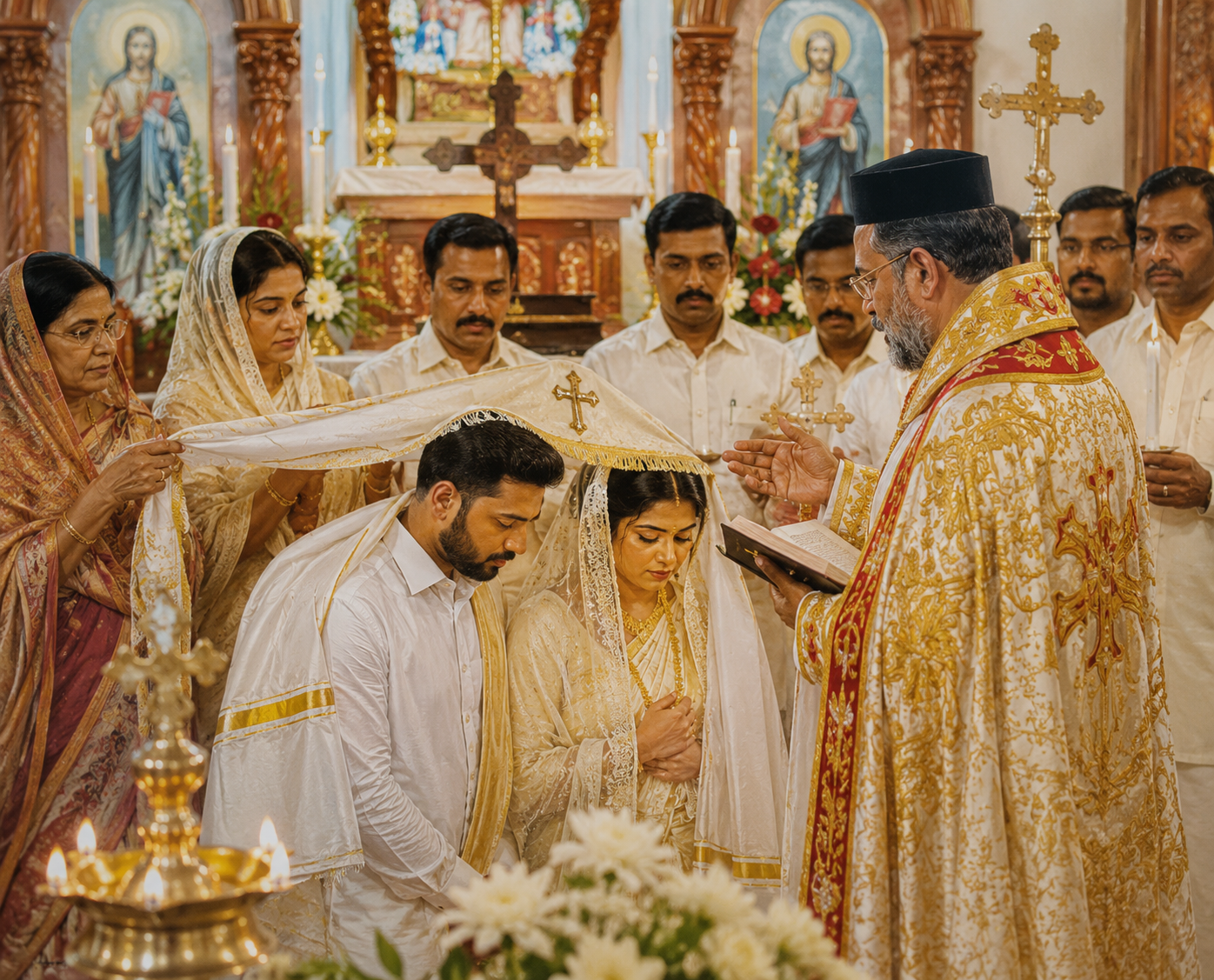
The publisher of the second edition of Ancient Songs seeks to explain why this hymn, which had formed an integral part of the Knanaya marriage tradition since ancient times, eventually became unfamiliar among the Knanaya Jacobites. P. U. Lucas concludes that this occurred because the Antiochene Jacobite community, having adopted West Syriac as its liturgical language, gradually abandoned Bur Maryam, a hymn composed in the East Syriac language and rooted in East Syriac theology.
Lucas’s further observation is equally significant. He writes that the hymn serves as “an excellent means of expressing the community’s bond with, remembrance of, and reverence for its forefathers, their homeland, and their liturgical tradition.” This insight remains relevant even today. For the Chaldean Syriac Knanaya community, Bur Maryam continues to provide an opportunity to commemorate and honour its ecclesiastical heritage, its ancestral homeland of Babylon, and the Chaldean liturgical tradition, while recalling the legacy of its spiritual forefathers and saints, including St. Thomas the Apostle, Mar Addai, Mar Mari, Mar Quryaqos and Julitta, Mar Aphraates, Mar Knai Thoma, Mar Joseph of Edessa, St. Ephrem, and Jacob of Serugh.
Joseph Chazhikadan (1940)
In his work The Syrian Colonization of Malabar, or the History of the Southist Community (Suriyanikkarude Keralapravesanam Athava Thekkumbhaga Samudaya Charithram), published in 1940 by the Kottayam Catholic Mission Press, Joseph Chazhikadan discusses the Bur Maryam hymn on pages 8–9.
He argues that the continued singing of Bur Maryam at Knanaya weddings provides convincing evidence that, even before the emergence of Malayalam wedding songs, the early immigrants led by Knai Thoma possessed their own marriage hymns in the Syriac language. He writes that the long Syriac hymn beginning with the words Bur Maryam is still sung in Knanaya Catholic churches immediately after the completion of the marriage rite by the clergy together with the faithful assembled for the wedding.
According to Chazhikadan, the custom of singing this Syriac hymn at the conclusion of the church marriage ceremony is unique to the Knanaya Catholics. Since the hymn continues to be sung in Syriac, is reserved exclusively for weddings, and is practised only among the Knanaya Catholics of Malabar, he concludes that the tradition of singing hymns during marriage celebrations must have originated before the Knanaya settlers adopted Malayalam as their spoken language.
Joseph Kurmankkan (1944)
The Bur Maryam hymn is also discussed by Joseph Kurmankkan in his 1944 critical review entitled The Southists and the Northists: A Review of Joseph Chazhikadan’s The Syrian Colonization of Malabar, or the History of the Southist Community. On page 447 he writes:
“There is a custom among the Southists of singing the Syriac hymn Bur Maryam at the conclusion of the marriage ceremony in the church. This is, in fact, a hymn associated with the Feast of Denha (Epiphany). In earlier times it was sung at Kuravilangad and elsewhere during the procession around the cross before the midday Holy Qurbana on the Feast of Denha. Since the hymn has no intrinsic connection with marriage, I fail to understand what special significance the Southists derive from singing it at weddings. It merely serves as an additional ceremony distinguishing them from the Northists.”
Although Kurmankkan wrote this work as a response to Chazhikadan, he does not entirely reject Chazhikadan’s observations regarding Bur Maryam. His statement that the hymn was sung at Kuravilangad on the Feast of Denha provides the earliest known indication that Bur Maryam may also have been used in Kerala outside the Knanaya community.
At the same time, Kurmankkan does not claim that the hymn was sung anywhere else within the vast Syro-Malabar Church extending from the Bharathapuzha River to the Pampa River, apart from Kuravilangad, situated near Kaduthuruthy, the historic mother parish of the Knanaya community. Nor does he explain why this practice later disappeared or was discontinued.
Furthermore, neither Fr. Bernard Thoma’s monumental work Mar Thoma Christians (1916), prepared with the encouragement of Fr. Nidhirikkal Manickathanar of Kuravilangad and based upon extensive documentary research, nor Dr. P. J. Thomas’s Malayala Sahithyavum Christianikalum (1961), also authored by a native of Kuravilangad, contains any reference either to the Bur Maryam hymn in general or to its alleged use at Kuravilangad in particular.
Nevertheless, Kurmankkan explicitly acknowledges that the singing of Bur Maryam as part of the marriage ceremony remained a distinctive custom of the Southists (Knanaya), while admitting that he himself could not perceive the theological or liturgical significance of its use in that context.
Fr. Placid J. Podipara (1980)
In Mariology of the East (1980), Fr. Placid J. Podipara makes the following observation on page 38:
“There is a hymn known as Bur Maryam (‘Son of Mary’). It is sung by the clergy and the faithful of the Southist (Knanaya) community belonging to the Chaldeo-Malabar Rite as a liturgical chant at the conclusion of the marriage ceremony.“
Fr. Placid Podipara occupies a unique place in the post-hierarchical history of the Syro-Malabar Church. He was one of the foremost architects of modern Syro-Malabar historical scholarship and played a decisive role in the Church’s theological and ecclesiastical development. Among his greatest achievements was the formation of a distinguished generation of scholars, including Fr. Jacob Kollaparambil.
It is therefore significant that Fr. Podipara explicitly records the fact that Bur Maryam is sung by the Knanaya community during the marriage ceremony. In the same work (pp. 38–42), he offers an English translation of the hymn together with an explanatory study. That translation has served as the principal source for the present Malayalam translation.