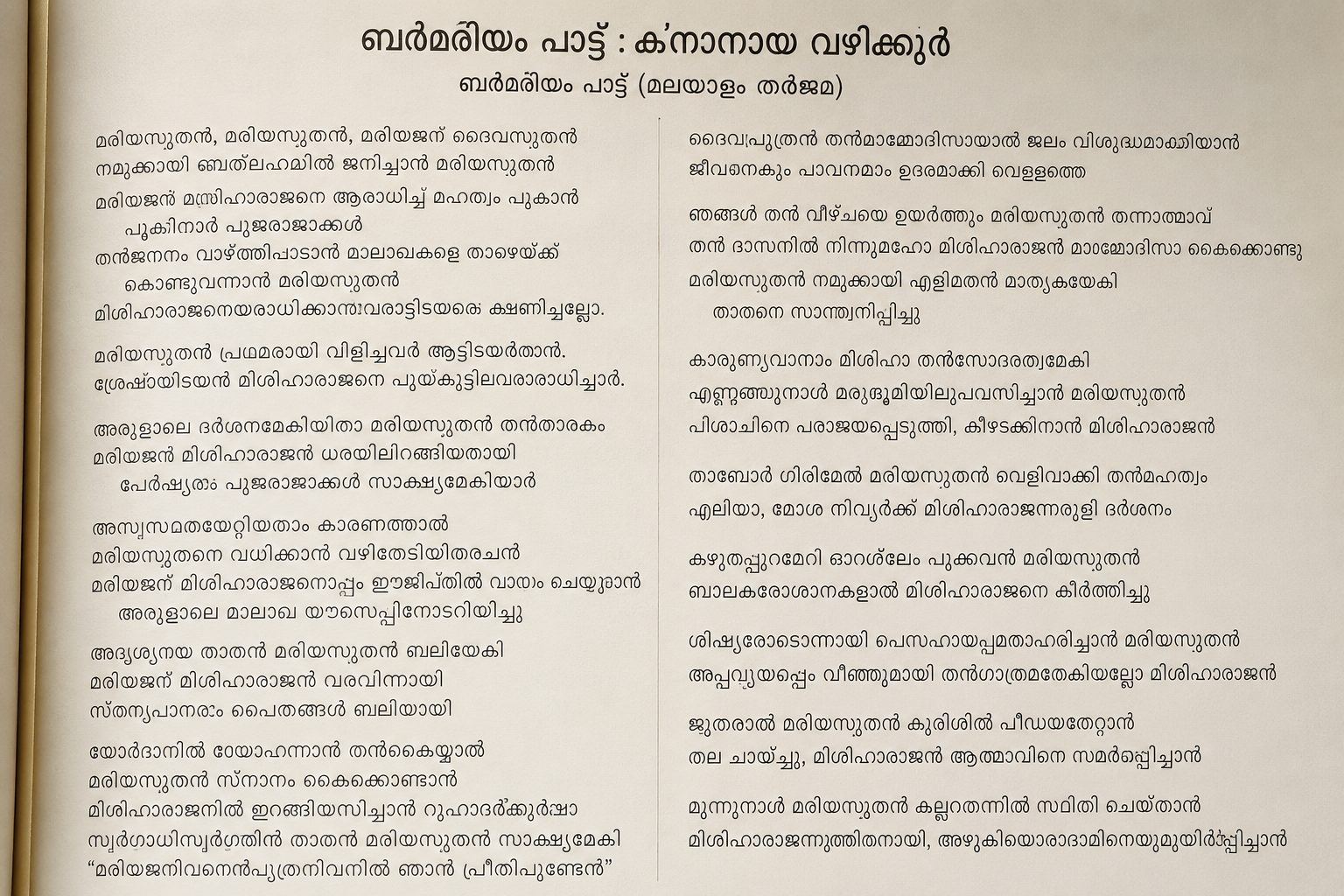
The question raised by Mr. Kurmankan in 1944—what distinctive significance is gained by singing this hymn during the marriage ceremony, even though it does not directly refer to marriage—is indeed relevant. To understand this significance, one must understand the profound theological understanding of marriage held by the Knanaya ancestors.
Among the traditions associated with marriage, the ceremony of applying henna, held at the bride’s home on the night immediately preceding the wedding, deserves particular attention. The henna song is sung as follows:
On this day, for the maidens to prosper in marriage,
They shall be covered with green leaves and henna.
Because the fruit was plucked by hand,
Henna is applied to the palm of the hand.
Because the fruit was eaten after walking upon the feet,
Henna is applied to the toenails.
This contains an implicit indication that the henna ceremony is performed as an outward symbol of deliverance from the sin of our first parents.
Through the hymn Barmariam, the priest introduces to the newly married couple Jesus, who, for the salvation of all humanity, ascended the wood of the Cross, descended to the realm of the dead, and raised up Adam, who had been corrupted by sin after succumbing to the temptation of the tree. The hymn also presents Jesus as the one who, through the Holy Spirit, the Helper, made the Apostles wise and enlightened.
The priest reminds the couple that married life is not meant merely for the enjoyment of worldly pleasures. Rather, through their mutual love, holy life, and the raising of their children—the gifts of God—in holiness, they are called to participate in the salvific plan of Christ.
Ultimately, the hymn conveys the profound truth that salvation is found in the Cross and in the One who died upon it. It also suggests that the crosses encountered in married life can bring consolation when they are united with the exalted Cross of Christ.
The reference in Barmariam to the discovery of the Cross on September 13 is connected with the Feast of the Exaltation of the Holy Cross, commemorating the discovery of the true Cross of Jesus at Golgotha by Queen Helena, the mother of Emperor Constantine, and the construction and dedication of a church there in AD 335. In ancient times, this feast was celebrated over two days. Today, September 14 is observed as the Feast of the Exaltation of the Holy Cross.
This also symbolically expresses the idea that married life becomes truly blessed and fulfilling when the newlyweds, like Christ the King who ascended the Cross and sacrificed his own life for the salvation of humanity, are willing to sacrifice themselves for one another out of love.
The hymn further reminds the bridegroom that he should follow the example of Jesus, who made the Church his Bride. Christ, who sacrificed his life for the Church, his Bride, and the Church, which remains faithful to Christ, her Head, together constitute an enduring and exalted model for married couples.