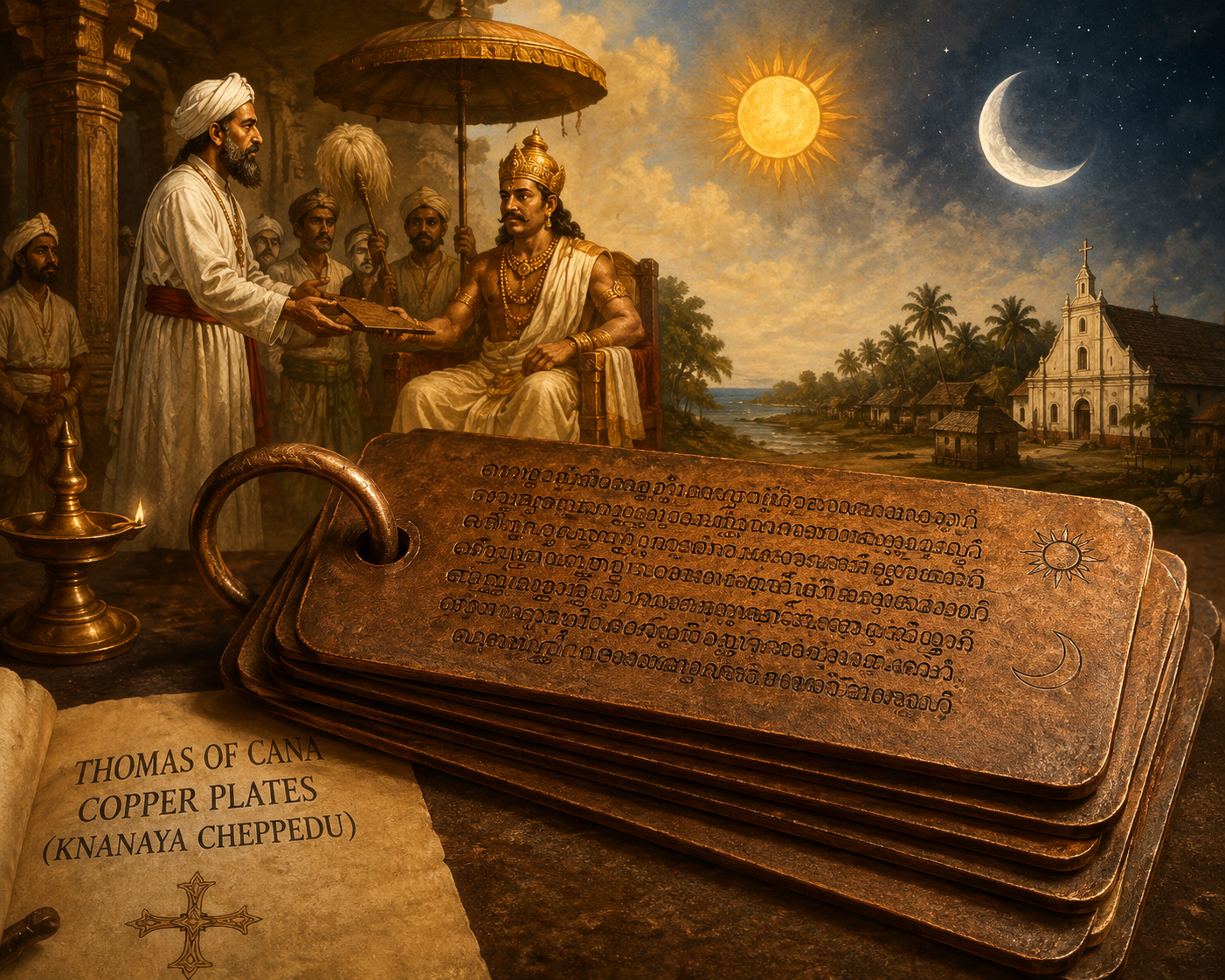
At times, people have questioned whether there was only one king or several kings ruling Kerala during that period. However, there can be no doubt that the privileges mentioned above were inscribed on copper plates, with the sun and the moon invoked as witnesses. In other words, as the document itself declares, these privileges would endure as long as the sun and the moon exist. The chief among the rulers of Kerala, to whom Cherigon Perumal (converted by St. Thomas the Apostle) had entrusted the administration of the divided kingdom, was known as Sakkara Vithiyan. It was he who, at the request of Knai Thoma (Thomas of Cana), granted the numerous privileges referred to above.
This passage is taken from MS Sloane 2748A, preserved in the British Museum, a report written around 1676. According to Rev. Fr. Jacob Kollaparambil, its author was Fr. Matthew of St. Joseph, a Carmelite priest who lived in Kerala for more than fifteen years over two separate periods. His arrival in Kerala as an assistant to Fr. Sebastiani and his close association with Mar Chandy Parambil, the first native bishop of India, undoubtedly contributed to the accuracy and richness of these descriptions.
Fr. Joseph Kariattil
Among the St. Thomas Christians mentioned earlier, there exists a small group numbering between twenty-five and thirty thousand members, known as the Thekkumbhagar (Southists). Although they belong to the same Christian rite, they have preserved their foreign family names and continue to observe many customs—especially those connected with marriage—that are not found either in the practices of their own Church or in those of the Roman Church.
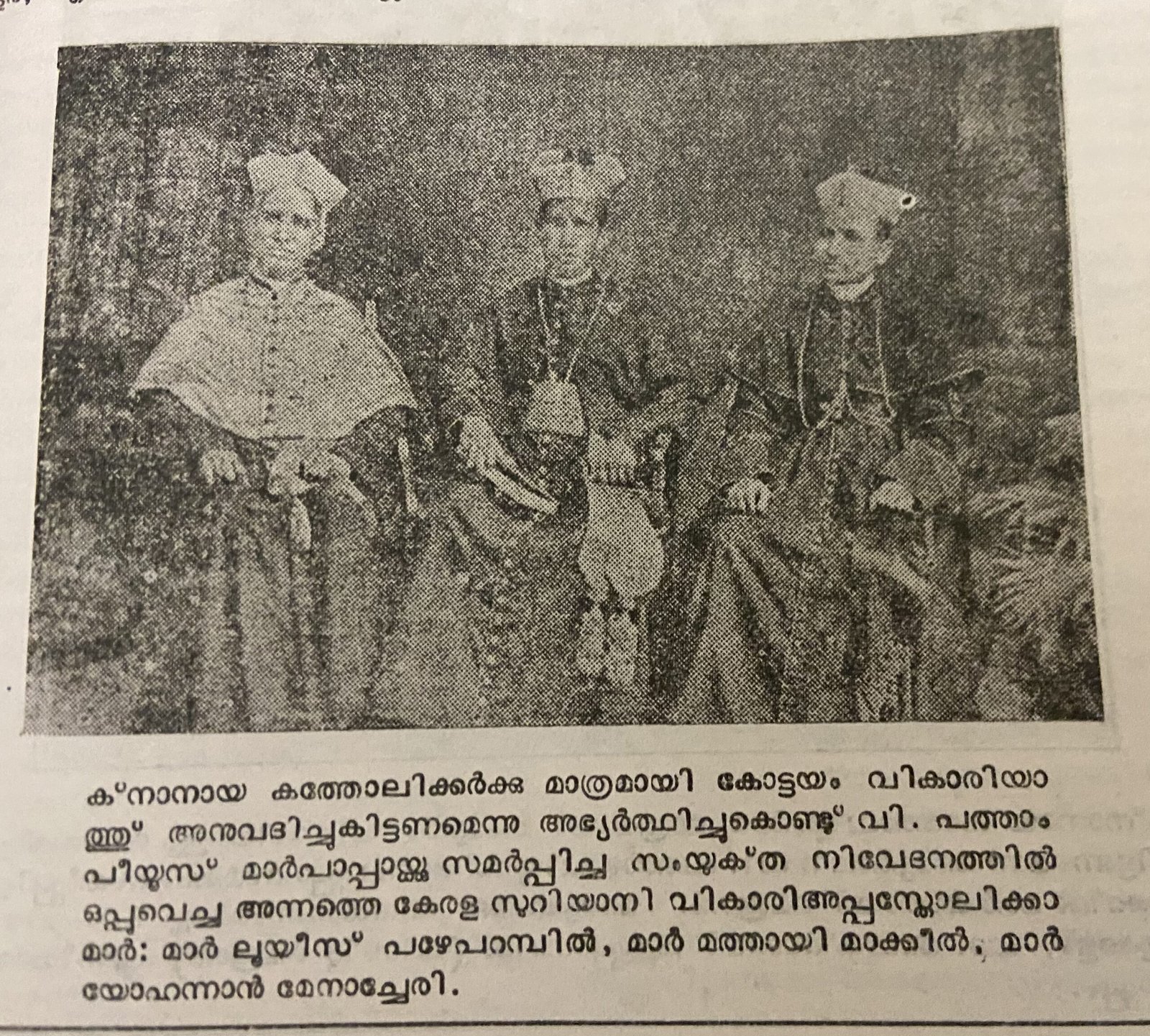
Fr. Joseph Kariattil, who obtained his doctorate from the renowned College of Propaganda Fide in Rome, led the delegation that travelled to Europe to resolve the divisions within the Church in India. This mission was made possible largely through the financial support of the Knanaya community, particularly the Poothathil family of Neendoor. He was also consecrated in Portugal as the first native Metropolitan of India. The above quotation is taken from his work entitled The Affairs of the Kingdom of Kerala. Although it does not specifically discuss the Thomas of Cana Copper Plates or their privileges, it clearly records that the Southists practised many customs distinct from those of the Northists, especially in connection with marriage ceremonies. Though Fr. Kariattil was an Indian, the original document was written in Portuguese; hence it has been included here.
Fr. Matthew Vettikoottil
“The Christians of Kerala immediately accepted them. All of them together approached their brethren who had come from abroad for guidance. Thereafter, they went to Sherkoon, the king who ruled the whole of Kerala, and presented him with gifts. Pleased with these offerings, the king declared: ‘Whatever you ask of me, I shall grant you.’ He gave them the spacious land they desired. In addition, he granted them all the honours and privileges enjoyed by those close to the king, recording them on copper plates. These copper plates have been carefully preserved among us to this day. After receiving all these grants from the king, they returned to Maliankara to build a church and establish a town. At Kuramkulur, on the land bestowed upon them by the king, they built a church and a town consisting of 472 houses, extending from east to west, and settled there in due course.”
The reference to the copper plates is found in the manuscript “The History of the Syrians of Malabar”, copied and transmitted in 1720 by Fr. Mathai Vettikoottil, a priest belonging to the community under the Nestorian Metropolitan Mar Gabriel in Kerala. This manuscript has been included in our study as part of the indigenous documentary tradition concerning the copper plates. The passage presented here, however, is translated from another document believed to have been composed by Fr. Mathai himself in Syriac language and script, based on earlier historical works preserved in Kerala. This manuscript is preserved as MS 1213 in the Leiden Academy in the Netherlands. The quoted passage appears after a detailed narration of the arrival of Thomas of Cana in Kerala.
(Among the foreign records relating to the Thomas of Cana Copper Plates before the nineteenth century, another document of considerable importance is the French translation of the Tharisapalli Copper Plates prepared by Abraham Hyacinthe Anquetil-Duperron.)
Conclusion
Presented here are the portions relating to the Thomas of Cana Copper Plates extracted from documents written in various foreign languages. Based primarily on the discoveries of Rev. Fr. Jacob Kollaparambil, who published these texts together with English translations, Malayalam translations have been prepared and accompanied by brief explanatory notes.
To date, sixteen foreign documents, all predating the nineteenth century, have been identified as referring to these copper plates. In addition, numerous studies concerning the plates have appeared during the nineteenth, twentieth, and twenty-first centuries. Owing to limitations of space and time, those later works have not been included here.
In the light of the abundant documentary evidence presented through these records, it is difficult to doubt the historical reality of the Thomas of Cana Copper Plates. Those who continue to question their authenticity are, paradoxically, successors of St. Thomas the Apostle, whose own Gospel tradition calls for a careful examination of evidence.
These records contain not only translations of the copper plates—made at different times—but also valuable information about them. They help us understand the identity of the donor and recipient, the witnesses, the social standing of the beneficiaries, the privileges granted, the location involved, and even the royal permission to build a church. It is possible that among these documents there still lies a hidden clue that may one day lead to the rediscovery of the original copper plates, long believed to have been lost. May the search for that crucial clue become one of our foremost responsibilities.