Introduction
The purpose of this chapter is to introduce the Tharisapalli Copper Plates in relation to the Knanaya Thomas (Knai Thoma) Copper Plates. Among the most significant inscriptions in the study of Malayalam epigraphy, the Tharisapalli Copper Plates continue to be a subject of active scholarly discussion because of their unique historical, linguistic, and cultural importance. Ever since they attracted the attention of researchers, these plates have remained the focus of academic study, debate, and controversy. Questions regarding the rightful beneficiaries of the privileges recorded in the charter, whether the inscription consists of one or two charters, the number of plates, the date of composition, the reading and translation of the text, its interpretation, and the history of its custody have all given rise to differing scholarly opinions.
Beyond illuminating the evolution of the Malayalam language and the features of its early grammar, the Tharisapalli Copper Plates also provide valuable insights into the history and culture of Kerala and of the various trading communities that maintained commercial relations with the region. There are also historical links between the Knanaya community of Kodungallur—descendants of the Syriac Christian merchant settlers who migrated from Persia—and the Christian merchant community that was centered around the Tharisapalli at Kollam. Furthermore, two extant copies of the Tharisapalli Copper Plates indicate that they contain a summary of the privileges recorded in the Knai Thoma Copper Plates. These connections, together with other historical considerations, provide compelling reasons to study the Tharisapalli Copper Plates in relation to the Knai Thoma Copper Plates.
General Description
The Tharisapalli Copper Plates are known by several names depending on their nature, purpose, provenance, and custodial history. Since the charter is engraved on copper plates, it is commonly referred to as the Tharisapalli Copper Plates. As a royal legal document, it is also known as the Tharisapalli Charter or Royal Charter, and because it records a grant of land and privileges, it is described as a land grant (patta). Since the grant was issued to the Tharisapalli at Kollam, it is known as the Tharisapalli Copper Plates/Charter/Grant. It is also called the Quilon (Kollam) Copper Plates, as it is associated with the city of Kollam. Because the plates were once preserved in the residence of the Tarakan family at Thevalakkara, they are sometimes referred to as the Thevalakkara Copper Plates. Likewise, as they were for a long period kept in the Old Seminary at Kottayam under the Puthenkoor community, they have also been known as the Kottayam Copper Plates. Since the grant was issued to the Syriac Christian community, the inscription is also widely referred to as the Syrian Christian Copper Plates.
From the time of Rev. Hermann Gundert until Fr. Bernard Thoma, scholars generally regarded the Tharisapalli inscription as a single charter. Beginning with T. A. Gopinatha Rao, however, secular historians interpreted it as two incomplete and independent charters. Eminent historians such as Elamkulam P. N. Kunjan Pillai, A. Sreedhara Menon, and M. G. S. Narayanan followed this interpretation. A significant shift occurred with the publication of Tharisappalli Pattayam (2013) by M. R. Raghava Varier and Kesavan Veluthat, in which the inscription was once again studied as a single unified document. It is noteworthy that, even while the dominant secular historiography continued to regard the inscription as two separate records, Rev. Jacob Kollaparambil had already argued in 1987, in his contribution to the book Symposium on Knanaites, that it should be understood as one continuous charter. The conclusions reached by later historians lend considerable support to Kollaparambil’s earlier position. An important factor behind his interpretation was his discovery of the Karshoni (Malayalam written in Syriac script) copy of the Tharisapalli Copper Plates, a manuscript that, despite its significance, has not yet received the scholarly attention it deserves.
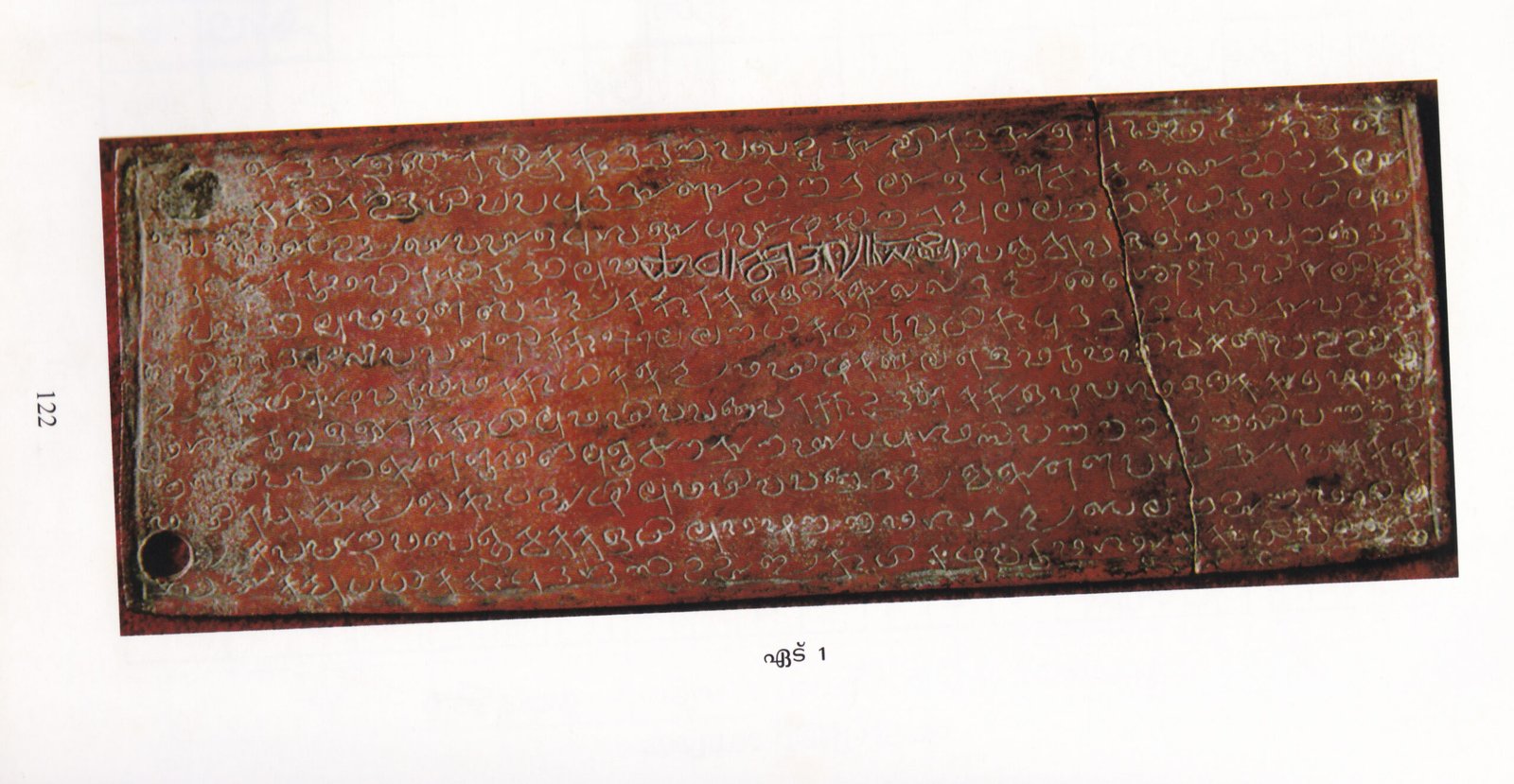
Five copper plates, believed to constitute the extant portion of the Tharisapalli Charter, are currently preserved. Plates 2, 3, and 4 are housed at the Catholicate Palace, Devalokam, Kottayam, the headquarters of the Malankara Orthodox Syrian Church, while Plates 1 and 5 are preserved at the Mar Thoma Headquarters, Poolatheen, Thiruvalla. The first and fourth plates measure approximately 8.8 × 3.2 inches, whereas the second, third, and fifth plates measure about 9.1 × 3.3 inches.
The language of the first four plates is an early form of Malayalam closely related to Tamil. These plates are written primarily in the Vattezhuthu script, with a few individual letters and words appearing in the Grantha script, which is closer to the modern Malayalam script. The fifth plate, generally believed to form part of the same charter and containing the names of witnesses, is inscribed in Kufic Arabic, Sasanian Pahlavi, and Hebrew scripts, representing the Arabic and Persian languages. The first three plates also bear an identical word or symbol written in an as yet unidentified script. The obverse of the first plate contains no inscription, while the fourth plate ends abruptly, indicating that the surviving charter is incomplete.
Copies
In addition to the surviving original copper plates, three important early copies of the Tharisapalli Copper Plates are available today. These copies have played a significant role in the preservation, interpretation, and scholarly study of the charter.
1. The Karshoni Copy (c. AD 1601–1615)
A copy of the charter written in Karshoni (Malayalam transcribed in Syriac script) during the period 1601–1615 was discovered in the National Library of France (Bibliothèque nationale de France, Paris) by Rev. Jacob Kollaparambil. He published a facsimile of the original Karshoni manuscript, its transcription into the Malayalam script, explanatory notes, and a detailed study in the proceedings of the Symposium on Knanaites (1987). Following his death, his posthumously published work, The Sources of the Syro-Malabar Law (2015), presented his hypothesis regarding the history and origin of this Karshoni copy in greater detail.
2. The French Translation by Abraham Hyacinthe Anquetil-Duperron
While conducting research on the Zend Avesta, the sacred scriptures of the Parsis, the French Orientalist Abraham Hyacinthe Anquetil-Duperron visited Kerala and prepared a French translation of the Tharisapalli Copper Plates. He incorporated this translation into his celebrated work Zend Avesta, published in 1771, making it one of the earliest European translations of the charter.
3. Walter Elliot’s Facsimile (1841)
After Colonel Colin Macaulay rediscovered the copper plates in 1806, Walter Elliot prepared a facsimile—an exact engraved reproduction of the original copper plates—with the assistance of F. C. Brown and Rev. Benjamin Bailey. This facsimile was published in 1841 in the Journal of the Royal Asiatic Society. The original facsimile is now preserved in the archives of the University of Cambridge, where it continues to serve as an important resource for epigraphical research.
Previous Studies
The Tharisapalli Copper Plates have attracted scholarly attention for more than five centuries. The following are some of the most significant milestones in the history of their study:
1. Fr. Gouvea (1504; published 1606)
The earliest known reference to the Tharisapalli Copper Plates is found in Fr. António de Gouvea’s Jornada do Arcebispo de Goa Dom Frey Aleixo de Menezes (written in 1604 and published at Coimbra in 1606). Gouvea records that when Archbishop Dom Aleixo de Menezes visited Kollam in 1599, the custodians of the church at Thevalakkara showed him the copper plates. He also provides a brief description of the document. This is generally regarded as the earliest surviving written account of the Tharisapalli Copper Plates.
2. Fr. Diogo Gonçalves, S.J. (1615)
In his Historia do Malavar (1615), Fr. Diogo Gonçalves, S.J. records that, at the direction of Bishop Mar Francis Ros, the charter was read in 1601 by Itti Mani Kathanar and Manuel de Sousa, while Manuel Perez prepared a Portuguese translation. At the time, a dispute had arisen concerning the revenues and privileges attached to the Tharisapalli Charter. The question was whether these rights belonged to the Latin Christians who possessed the original Tharisapalli or to the Syriac Christians who had subsequently established another church nearby.
Following the establishment of the Diocese of Cranganore for the Syriac Christians in 1600, a jurisdictional dispute developed between the Diocese of Cochin and the new diocese. To resolve the matter, the copper plates were examined, copied, and translated into Portuguese. The final decision recognized the Syriac Christian church at Kollam as the principal beneficiary of the revenues, while directing that a portion should also be allotted to the local Latin church.
Rev. Jacob Kollaparambil has further suggested that it was on this occasion that Itti Mani Kathanar prepared the Karshoni copy of the charter. According to his hypothesis, this manuscript was later inadvertently incorporated as the final four folios of a Chaldean Syriac liturgical manuscript (Syriac Manuscript No. 186) now preserved in the National Library of France.
3. Anquetil-Duperron and the Eighteenth-Century Copy
Abraham Hyacinthe Anquetil-Duperron notes in his Zend Avesta that, at the request of Bishop John Baptist Multhedi of Verapoly, a copy of the charter had been prepared. He further records that, under the instructions of Bishop Florence of Jesus, Fr. Mathew Kathanar, Vicar of Anjikaimal Church, supplied a Malayalam (described as “Sanskrit” in the source) copy of the charter dated 14 January 1758. Anquetil-Duperron also prepared and published a French translation of the document, thereby making the Tharisapalli Copper Plates accessible to European scholarship.
4. Modern Epigraphical Studies
The publication of Walter Elliot’s facsimile of the Tharisapalli Copper Plates in the Journal of the Royal Asiatic Society in 1841 marked the beginning of modern scholarly research on the inscription. Thereafter, numerous studies appeared in journals such as the Madras Journal of Science and Literature, Indian Antiquary, Epigraphia Indica, The Asiatic Review, Kerala Society Papers, and in major reference works including the Travancore Archaeological Series.
Over the past two centuries, the charter has been studied by a distinguished group of scholars, including Swanston, Hermann Gundert, Ellis, Walter Elliot, West, A. C. Burnell, Eugen Hultzsch, Benjamin Bailey, F. C. Brown, Venkayya, Bernard Thoma, F. Kielhorn, Shakespeare, Burkitt, Winkworth, K. N. Daniel, T. K. Joseph, Hosten, K. G. Sankar, Monteiro d’Aguiar, Georg Schurhammer, T. A. Gopinatha Rao, K. P. Padmanabha Menon, Ramaswami, Elamkulam P. N. Kunjan Pillai, M. G. S. Narayanan, Purushothaman Nair, M. R. Raghava Varier, T. V. Mahalingam, Cheraethi, Purcell, and Rev. Jacob Kollaparambil. Their studies have addressed a wide range of issues, including the charter’s date, language, script, historical context, legal significance, textual interpretation, and its relationship to the history of Christianity and commerce in medieval Kerala.
Date of the Inscription
The Tharisapalli Copper Plates state that the charter was issued in the fifth regnal year of the Chera ruler Ko Tanu Ravi Kuttan (Ko Tanu Ravi Varma). Unlike the Iravikorthan Copper Plates and the summary of the Knai Thoma Copper Plates, however, the Tharisapalli Charter does not provide an astronomical date that can be used to establish its chronology with precision. Apart from noting that the Tharisapalli church had already been constructed and that the ceremonial inauguration (nīrāṭṭu) had already taken place, the inscription offers no internal chronological indicators that can serve as an independent basis for dating. Consequently, the date of the charter depends upon identifying the fifth regnal year of Ko Tanu Ravi.
Scholars have proposed widely differing dates for the composition of the inscription. Fr. Bernard Thoma assigned it to AD 250, while A. C. Burnell dated it to AD 824. Modern Kerala historians, beginning with Elamkulam P. N. Kunjan Pillai, have generally accepted AD 849 as the most probable date. T. K. Joseph suggested a date close to AD 880, whereas T. A. Gopinatha Rao, relying primarily on palaeographical evidence—especially the style of the script—placed the first charter in the late ninth or early tenth century.
The dating proposed by Elamkulam is based on a different line of evidence. By correlating chronological data derived from other contemporary inscriptions, particularly those containing astronomical references, he concluded that the reign of Ko Tanu Ravi commenced in AD 844. If this reconstruction is correct, the fifth regnal year falls in AD 849, making that the most likely year in which the Tharisapalli Copper Plates were issued. This dating has subsequently been accepted by many later historians and remains the prevailing scholarly opinion.
Contents of the Charter
The Tharisapalli Copper Plates constitute a royal charter issued in the fifth regnal year of the Chera emperor Ko Tanu Ravi Kuttan, by Ayyanadikal Thiruvadikal, the ruler of Venad, granting extensive privileges to the Tharisapalli and its associated Christian merchant community.
The charter conveys a large tract of land to the church as a tax-free grant, with its boundaries carefully defined. In addition to the land grant, families belonging to various occupational and social groups—including Ezhavas, Vellalas, carpenters (Taccars) and others—were assigned to the church as hereditary service communities. These groups were exempted from several taxes and customary dues, such as Thalaikkanam, Enikkanam, Menippon, Polippon, Iravuchoru, and Kudanazhi.
The charter also conferred important civil and commercial privileges. The beneficiaries were granted the right to enter the royal fort for official work, to bring their vehicles and merchandise into the market, and to engage freely in trade. Judicial authority over offences committed by or against members of the Tharisapalli community was vested exclusively in the church authorities. Royal officials, including the Thiyamazhvanmars and Mathil Nayars, were specifically prohibited from exercising jurisdiction over them.
The church was further granted the authority to maintain official weights and measures and to collect the corresponding weighing fees. The merchant guilds known as Anjuvannam and Manigramam were entrusted with numerous responsibilities, including the protection of the church and its properties, and were accorded extensive commercial rights together with exemptions from customs duties and other levies.
Finally, the charter bestowed the celebrated seventy-two privileges (viduperu/padavikal) upon the beneficiaries, declaring that these rights were to remain in force for as long as the earth, the sun, and the moon endure. This perpetual grant underscores the exceptional legal and political status accorded to the Tharisapalli and its merchant community by the Chera and Venad rulers.
Donor: Ayyanadikal Thiruvadikal
The donor of the Tharisapalli Copper Plates is Ayyanadikal Thiruvadikal, the ruler of Venad. According to the charter, the grant was made after deliberation by Ayyanadikal Thiruvadikal, his officials (adhikarar), the prakriti (council of dignitaries), the merchant guilds Manigramam and Anjuvannam, and the Punnathala-pathi. The charter records that the grant was made in favour of the church built at Kurakkeni Kollam by Iso Datapir (Maruvan Sapir Iso).
The grant was executed in the presence of several distinguished witnesses, including Viyarakan Thevar, the Koyiladhikari (royal representative), Rama Thiruvadi, the ruler of Ilangur, together with the adhikarar, the prakriti, the Arunurruvar, the Punnathala-pathi, and the Pulakkudipathi. Their presence reflects the formal and public nature of the transaction and emphasizes the legal validity of the charter.
Although the charter was issued by Ayyanadikal Thiruvadikal, it is explicitly dated to the fifth regnal year of the Chera emperor Ko Tanu Ravi Kuttan. Furthermore, the repeated references to the presence of the Koyiladhikari, the representative of the Chera sovereign, indicate that the grant was made under the authority and overlordship of the Chera king. This strongly suggests that Ayyanadikal Thiruvadikal was the ruler of Venad who acknowledged the suzerainty of the Chera Perumal, exercising regional authority while recognizing the supremacy of the Chera crown. This relationship explains why the charter bears both the regnal year of the Chera emperor and the active participation of the royal representative in the execution of the grant.
Witnesses: The Perumal, the Royal Representative, Officials, and Foreign Merchants
The Koyiladhikari (royal representative), Viyaraka Thevar, was present at the formal execution of the Tharisapalli Copper Plates as the representative of the Chera king. Significantly, wherever the charter records the transfer of major rights and privileges, the first authority mentioned is Viyaraka Thevar, acting on behalf of the Perumal. His repeated appearance in the document, together with the fact that the charter is dated according to the fifth regnal year of Ko Tanu Ravi, strongly indicates that the grant was made with the knowledge and approval of the Chera sovereign.
Further support for this conclusion is found in both the Karshoni copy of the Tharisapalli Charter and Anquetil-Duperron’s French translation, which include a summary of the Knai Thoma Copper Plates, recording the grant made by the Cheraman Perumal at Kodungallur. These traditions suggest that the Tharisapalli Charter was issued under the authority of the Chera monarch, even though the immediate donor was Ayyanadikal Thiruvadikal, the ruler of Venad.
Among the principal witnesses to the grant were Rama Thiruvadi, ruler of Ilangur, together with the adhikarar (officials), the prakriti (council), the Arunurruvar, the Punnathala-pathi, and the Pulakkudipathi. The surviving fourth plate preserves the complete name of one witness, Velkula Sundaran, and part of another name, Vichaiya…. In his French translation, Anquetil-Duperron records the names of seventeen witnesses, beginning with these two individuals, thereby preserving portions of the text that are no longer fully legible on the surviving copper plates.
Note: The fifth copper plate, which is generally regarded by many scholars as forming part of the Tharisapalli Charter, contains the names of witnesses inscribed in Kufic Arabic (eleven names), Sasanian Pahlavi (eleven names), and Hebrew (four names). According to the considered assessments of scholars such as Winkworth and Burkitt, who made authoritative studies of these inscriptions, the Pahlavi and Hebrew texts on the original plate are already in a poor state of preservation, while the nineteenth-century facsimile reproductions are in an even poorer condition. The Kufic inscriptions are in the Arabic language, whereas the Pahlavi and Hebrew scripts record Persian-language names. Since the present study does not regard this fifth plate as an integral part of the original Tharisapalli Charter, this discussion is treated here as a supplementary note rather than as evidence directly bearing on the charter itself.
The Reading of the Name “Iso dā Tapīrāyi”
In their work Tharisappalli Pattayam, M. R. Raghava Varier and Kesavan Veluthat read the name as “Esoda Tapīrāyi.” The present study, however, prefers the reading “Iso dā Tapīrāyi.” Although the first letter in the word Iso appears in Vattezhuthu in a form that could be interpreted as e, the following letters (śō and dā) are written in Grantha characters. Moreover, elsewhere in the inscription the repeated name “Sapir Iso” can naturally be divided into “Sapir” and “Iso,” where the long vowel marker closely resembles the sign used in the expression Iso dā Tapīrāyi. Likewise, the long vowel in “pī” of Sapir supports the reading of the initial word as “Īso” (Iso) rather than “Eso.” On palaeographical and linguistic grounds, therefore, the reading “Iso dā Tapīrāyi” appears preferable.
The Syriac particle dā functions as a genitive marker meaning “of” or “belonging to.” A familiar example is Rūḥā d-Qudshā (“the Holy Spirit,” literally “the Spirit of Holiness”). Accordingly, Iso dā Tapīrāyi means “Iso of Tapir” or “Iso belonging to Tapir.” It is therefore likely that Iso is the personal name, while Sapir (Tapir) represents either a family name or a place of origin.
The Title “Maruvan”
The title Maruvan has also been interpreted in different ways. The Syriac honorific Mar (“Lord,” “Master,” “Saint”) appears in Malayalam in the form Mārān, meaning “my Lord.” Expressions such as Maranatha (“Our Lord, come!”) and lines in ancient Malayalam Christian songs—such as “Mārān piṟannu Varughīsu kaikkoṇḍu” and “Mārānte munnūṟṟi nālppattianjil”—show that this title was originally applied to Christ and later extended throughout the East Syriac tradition to bishops and other eminent ecclesiastical figures. The present form Maruvan may represent a later phonetic development of this title. Another view derives the word from the Persian Mihrvān/Mehrvān, although this interpretation remains open to discussion.
The Meaning of “Tharisapalli”
Although the charter is formally granted to the Tharisapalli, the privileges it records extend not only to the church itself but also to its administrators and to the hereditary service families attached to it. Thus, the beneficiaries include both the institution and its dependent community.
The inscription mentions the name Tharisapalli four times, although the first occurrence appears in the form Tarusapalli. The origin of the word Tharisa has long been debated.
According to Fr. Bernard Thoma, the word derives from the Syriac Thrīsā (Trīsā), meaning “true faith” or “orthodox faith.” During periods of doctrinal controversy, those who remained steadfast in the true faith came to be known as Thrīsā, and the church associated with them naturally became known as the Tharisapalli, that is, “the Church of the True Faith.”
An alternative explanation has been proposed by M. M. Purushothaman Nair, the distinguished scholar who established the Manuscripts Library at the University of Calicut and discovered the celebrated medieval Malayalam work Thirunizhalmala. He argues that Tharisapalli may be understood as “the church of the Tharuthāykkal.” In early Malayalam Christian usage, Tharuthāykkal denoted Christians or believers. An example occurs in the traditional song of the Kaduthuruthy Valiyapally, which praises “Marthomamariyam who protects the community of the Tharuthāykkal.”
This interpretation also finds support in Syriac phonology. The Syriac letter Taw may be pronounced either t or s, depending upon the vocalization. Thus, forms such as Beth Shlihe may also be pronounced Besh Shlihe, and Thuvānīthā may become Thuvānīsā in liturgical usage. Since vowel-pointing was introduced comparatively late into Syriac writing, such phonetic variations are well attested.
The Identity of Sapir Iso
The present study further suggests that Sapir Iso may in fact have been none other than Mar Sapor, one of the Persian bishops—together with Mar Proth—who came from the Church of the East and were revered as saints in the Indian Church before the Synod of Diamper (1599). If this identification is correct, the Tharisapalli itself would have been the episcopal church of Mar Iso dā Tapīrāyi (Mar Sapor).
When the Latin Diocese of Quilon was established in the thirteenth century—the first Latin diocese in India—the Tharisapalli probably became its cathedral church. Following the arrival of the Portuguese, the church remained under Latin episcopal jurisdiction, while the Syriac Christian community established a separate church nearby.
After Mar Francis Ros became Bishop of Cranganore in AD 1601, a dispute arose concerning the revenues attached to the Tharisapalli Charter. The matter was eventually settled in favour of the Syriac Christian church, subject to the condition that 150 raja panams should be paid annually to the Tharisapalli.
The original Tharisapalli church was eventually claimed by the sea. Modern dredging operations undertaken to deepen the harbour of Kollam have been carried out in the area traditionally believed to have been occupied by the church.
Although the sea swallowed the church built by those who came across the ocean and founded the city of Kollam, the Tharisapalli Copper Plates that they left behind have ensured the enduring survival of their memory and have become one of the most valuable sources for reconstructing the cultural, commercial, and ecclesiastical history of medieval Kerala.