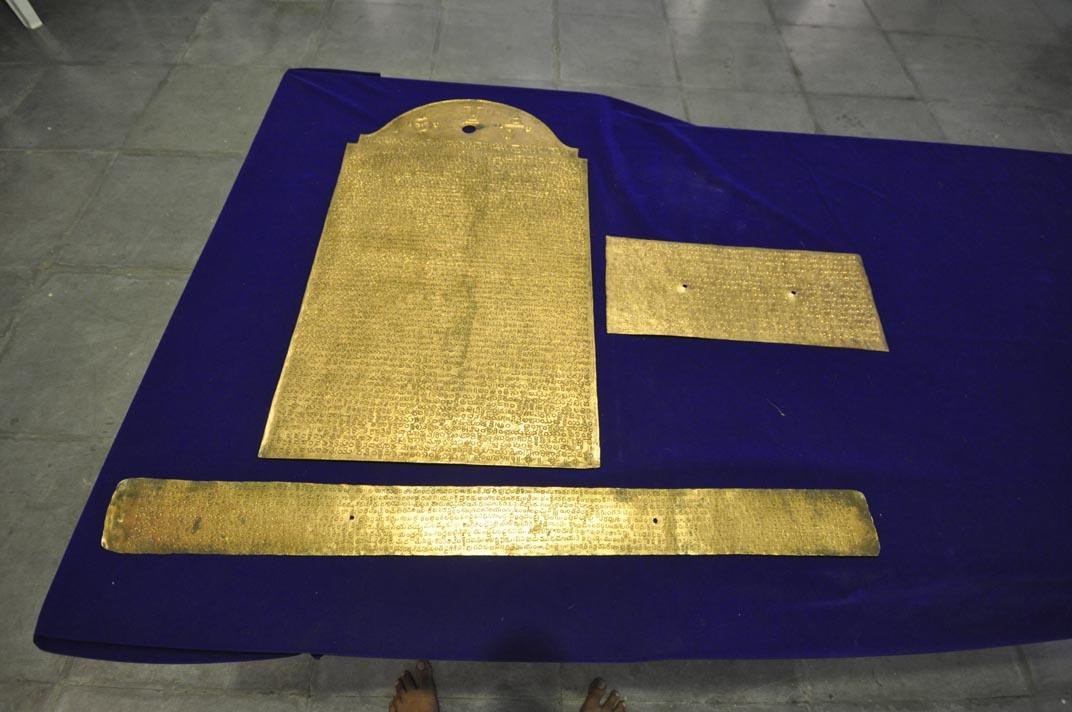
Among the historical records that provide information concerning the Knanaya Copper Plates, we have already examined the foreign-language historical documents up to the period when the copper plates were preserved in the Portuguese fort at Cochin. The reports that remain to be discussed are those of António de Gouvea, Ros, Campori, Diogo do Couto, de Trindade, Sebastiani, Mathew of St. Joseph, Kariyattil, Vettikkootel, and Du Perron. In the present article, however, only the records of the first two authors are examined. Here we encounter the earliest Portuguese translation of the copper plates.
Fr. António de Gouvea
“Among those who came to this country was an Armenian known as Thomas Cana, or, in their own language, Mar Thoma, meaning ‘Lord Thomas.’ Being a nobleman, a wealthy man, and a merchant engaged in extensive trade, he became highly esteemed and well known throughout the land. Consequently, as mentioned earlier, the King of Cranganore, the most powerful ruler in Kerala, showed him great favour and hospitality.
The king granted him a spacious plot of land upon which he built a magnificent church befitting the dignity and prestige of its founder for the Christians who had accompanied him. The king also bestowed upon them numerous privileges and honours, and all these grants were inscribed upon copper plates.
Mar Jacob, the bishop of these Christians, fearing that the copper plates might one day be lost, entrusted them to the custodian of the Portuguese fort at Cochin after the Portuguese had established their settlement there, so that they might be available whenever the Christians needed them. Owing to negligence, however, the copper plates remained in the office of the fort for many years until they eventually disappeared.
Among the privileges recorded in these copper plates were the exclusive right to wear the golden wedding crown during marriage ceremonies, the privilege of riding upon elephants, which was ordinarily reserved for members of the royal family, the right to sit upon carpets, and many other honours which were highly valued and recognised in Kerala but were not granted to other communities.
The Christians deeply lament the disappearance of these copper plates because, without these documents, they have no means of defending their ancient rights before the non-Christian rulers, who refuse to acknowledge these privileges.
The esteem in which these Christians held the copper plates is evident from an incident that occurred only a few years ago. The King of Paravur, having accepted a large sum of money, desired to transfer one of these privileges to certain Muslims living within his kingdom. As a result, violent conflict broke out between the Christians and the Muslims. Many people were killed, and considerable blood was shed on both sides.
It was on the basis of these privileges, together with the other honours bestowed by Cheraman Perumal, that the Christians of Kerala came to be regarded as people of high social standing. Throughout Kerala and Tamil Nadu they attained the distinguished status of those known as Rajamakkal (‘Royal People’).”
Fr. António de Gouvea was a Portuguese Augustinian missionary who later became a bishop. He wrote the book Jornada in 1603, describing the activities of Archbishop Dom Aleixo de Menezes in Kerala and the Synod of Diamper (Udayamperoor) held in 1599. The work was published at Coimbra in 1606 with the purpose of convincing the nations of Europe of the legitimacy of the Synod. Although Gouvea himself never visited Kerala, he provides an exceptionally detailed account of the region.
The expression Rajamakkal (“Royal People”), mentioned in the copper plates, together with the privilege of wearing the golden wedding crown (Ponnummudi/Vendanmudi) during marriage ceremonies, is characteristic of the Knanaya community alone. Likewise, the “conflict with the Moors (Muslims)” referred to in the above quotation most probably alludes to the Cochin–Calicut War fought at Cranganore in 1524, during which the Knanaya community finally abandoned Cranganore.
Mar Francis Ros
“According to their records (in the Portuguese report he refers to the copper plates by the word Olas), it is evident that Cheraman Perumal, the last Emperor of Kerala, granted land at Cranganore for the construction of a church and for the settlement of the Christians of Mar Thoma together with distinguished privileges. The original copper charter was taken to Portugal by the Franciscan missionaries, but a copy still remains here.
This Perumal is said to have died on 1 March, 1,258 years ago (346). The kings and local chieftains of the various kingdoms and principalities of Kerala who still exist today are the very witnesses who were present when the Perumal executed the charter. The charter itself thus proves that these palm-leaf records belong to the same Perumal.
It follows, therefore, that the dedication of the church at Cranganore took place more than twelve hundred years ago. It was founded in the month of April of the aforesaid year. Immediately afterwards, seventy-two houses were built there.
The occasion was as follows. As described in the Perumal’s charter, while the king was residing in a great palace at Paravur, situated opposite the church settlement across the river, he desired one day to go hunting. Accordingly, he entered the dense forest that occupied the site where the town of Cranganore now stands.
The king summoned a wealthy Armenian merchant from Babylon, named Thome Cananeo (Thomas Cana). After presenting the king with a substantial sum of money, Thomas purchased the entire tract of land. There he built a church dedicated to St. Thomas the Apostle and established a marketplace. The land that he purchased measured 264 square elephant-rods.
The authentic copy of the charter by which Cheraman Perumal granted this land at Cranganore to Thomas Cana reads as follows:
‘May the divine, God-fearing, powerful, truthful, righteous, perfect in good works, wise, sovereign over the whole earth, prosperous, victorious, glorious, and ever-growing in the service of God—Kokvarangon (Kocherakon)—enjoy prosperity and long life, and may he rule for a hundred thousand years at the great city of Mahodayapuram in Kerala.
During his reign, in the year when Mercury stood in Kumbha (Aquarius), on the seventh day of March, before the full moon, while the king was at Cranganore, there arrived by ship a distinguished man named Thome Cananeo, who had determined to travel to the farthest regions of the East.
Some who saw his arrival informed the king. The king himself came to meet this eminent man and summoned him into his presence. Thomas disembarked from the ship and appeared before the king, who received him graciously. Addressing him by the honorific title Cananeo, the king bestowed great honour upon him. Having accepted this distinction from the king, Thomas retired to his own residence to rest.
The king granted him the town of Magoderpattanam (Mahodayapuram) forever.
On another occasion, while the king was hunting in the forest at the height of his glory, he sent for Thomas in haste. Thomas immediately came before him. After consulting the royal astrologer concerning the auspicious time for founding a city in that forest, the king informed Thomas of his intention.
Thomas requested that, once the prescribed ceremonies had been completed, the forest itself might be granted to him. The king agreed and bestowed it upon him forever.
Accordingly, on the following day the forest was cleared. On the eleventh day of April of that same year, the king formally granted the land to Thomas and his descendants in perpetual possession.
The king himself laid the foundation stone of both the church and the house of Thomas Cananeo, and caused a public market to be established there for the benefit of all. He entered the church and offered prayers there on that very day.
Afterwards Thomas approached the king with gifts and petitioned that the land might belong to himself and to his descendants forever. The king measured out 264 square elephant-rods of land and granted it to Thomas and his posterity in perpetual inheritance.
At the same time sixty-two houses, together with gardens, trees, pathways, boundary lands, and courtyards, were immediately constructed there.
The king also granted Thomas the right to conduct himself and speak with the dignity of a king, the privilege of using seven kinds of musical instruments, the right of women to perform the ceremonial wedding ululation, and the privileges relating to official measures, carpets, ceremonial fans, the anointing of sandalwood paste upon the hands, wedding pavilions, and ceremonial wedding decorations throughout the kingdom forever.
In addition, the king conferred five further special honours upon Thomas, his descendants, his followers, the men and women of his community, his relatives, and his in-laws, to be enjoyed in perpetuity. All these privileges were granted by the king in his own name.
Witnesses to the Charter
The following eminent persons were witnesses to the royal grant:
- Kandan of Kodassery
- Chathan Komaran of Cherukarappuram – Chief Gatekeeper of the King.
- Aravindan Govindan – Royal Counsellor.
- Amenath Govindan Kerulan – Commander of the Army.
- Thrivikraman Komaran of Thirumalappuram – Chieftain of the eastern region of Kerala.
- Adityan of Perumbalanadu – Palace Singer.
- The Keeper of the Harbour at Kottakkulam, Perumbalanadu.
- Vikraman Chingan of Kaduthuruthy – Keeper of the King’s Bedchamber.
- The Scribe of the Great Temple at Arani, who wrote all these matters in his own hand and affixed the royal seal.
Commentary
This is the royal deed by which the Emperor of all Kerala granted the land at Cranganore to the Armenian Thome Cananeo (Thomas Cana) and the other Christians.
In those days, time was reckoned according to the movement of the planet Mercury, which repeated its cycle every twelve years. Hence the charter states that the town was founded “in the year when Mercury stood in Kumbha (Aquarius).” Since, for the past 779 years, the people of Kerala have reckoned time according to the Kollam Era, this earlier method of dating has long since fallen into disuse and has been forgotten.
Fr. Francis Ros, a native of Catalonia in Spain, was a Jesuit missionary who served in Kerala from 1585 onward and was also a professor at the Vaipicotta Seminary. Because he was highly proficient in Malayalam and Syriac, he served as an assistant to Mar Abraham, the last Chaldean bishop in India, and later acted as the secretary of Archbishop Aleixo de Menezes during the Synod of Diamper (1599).
When the Diocese of Angamaly was reorganized in 1599 to include the Syriac Christians, Francis Ros became its first bishop. He was consecrated bishop in 1601 by Archbishop Menezes. Subsequently, when the episcopal see was transferred and renamed the Archdiocese of Cranganore, he became its Metropolitan and continued in that office until 1624.
Francis Ros was personally involved in examining the Thomas Cana Copper Plates and the Tharisappally Copper Plates, or their translations, in order to settle a dispute concerning the revenues and privileges attached to the churches. The controversy concerned whether the income and rights associated with these ancient grants belonged to the Latin dioceses of Cochin and Quilon or to the Syrian churches of the Diocese of Cranganore.
His observations are preserved in the work Relação da Serra (“An Account of the Serra” or “Description of Kerala”), written in 1604.
Among all the surviving historical sources relating to the Thomas Cana Copper Plates, the most authoritative are:
- Two early Portuguese translations (those of Francis Ros and Diogo do Couto),
- One Portuguese summary (the Curzon Manuscript), and
- A French translation of that summary prepared by Du Perron.
These documents belong to the seventeenth and eighteenth centuries. The earliest among them is the Portuguese translation prepared by Francis Ros in 1604.
Ros also records that, through the efforts of Pero de Sequeira, a Portuguese translation of the copper plates had already been prepared between 1552 and 1556 and sent to the King of Portugal. At the same time, another copy (the Portuguese word traslado can mean either “translation” or “copy”) was made and preserved.
Since the original charter was written in three languages, the copy prepared at that time was most likely a Malayalam version produced with the assistance of a Jewish scholar. Francis Ros may either have translated that Malayalam copy into Portuguese or simply incorporated a copy of the Portuguese translation already prepared for the Portuguese king.
Thus, the Portuguese text found in Relação da Serra represents a translation into Portuguese of a sixteenth-century Malayalam rendering of the original trilingual charter, prepared centuries after the original document.
The Malayalam version presented here is itself translated from the English rendering prepared by Fr. Kollaparambil, while also being carefully compared with the original Portuguese text. Consequently, although differences in wording, style, and nuance may occasionally be noticed, the Knanaya community owes an immense debt of gratitude to Mar Francis Ros for preserving this invaluable historical record.
That gratitude is further increased by the fact that the Curzon copy of the Tharisappally Charter, which also contains a summary of the Thomas Cana Copper Plates, was likewise prepared through the efforts of Mar Francis Ros.