The Southist Knanaya community places the blessings of elders and spiritual guides above all other forms of blessing. Consequently, every effort is made to make the wedding day and its ceremonies deeply prayerful and grace-filled.
Sthuthi Chollal (Offering Praise)
Before leaving for the church, the family spreads a mat in the house, lights the traditional oil lamp (nilavilakku), and offers prayers. The bride and groom then stand before their parents, elders (known as Kārnnonmar—those responsible for giving them life), and respected teachers or spiritual mentors. With folded hands and bowed heads, they greet them by saying, “Eesho Mishihaikku Sthuthiyayirikkatte” (“Praise be to Jesus Christ”).
By paying homage to their elders and spiritual guides in this manner, the bride and groom seek inner peace, strength, and their heartfelt blessings as they approach one of the most significant moments of their lives. They pray that these blessings will accompany and sustain them throughout their married life.
Among Syriac Christians, the expression “Eesho Mishihaikku Sthuthiyayirikkatte” is commonly used when greeting priests and after family prayers. Although prayers accompany important life events such as birth and death, Sthuthi Chollal as a formal ceremony is found uniquely in Southist Knanaya weddings. The community has transformed this traditional greeting into an integral part of the marriage ritual.
The name Eesho Mishiha is derived from two Syriac words: Eesho (Saviour) and Mishiha (the Anointed One or Messiah). Instead of using the Malayalam word “Yesu Kristhu” (Jesus Christ), which entered Malayalam through Greek and Latin traditions, this ceremony deliberately retains the Syriac form Eesho Mishiha, highlighting both the Syriac origin and the antiquity of the custom. At the same time, offering this greeting to one’s parents, elders, and teachers reflects the Indian cultural ideal of reverence for Mother, Father, Teacher, and God.
After the ceremony, the bride’s or groom’s sister walks ahead carrying the lighted nilavilakku. Guided by this auspicious light, the entire wedding party proceeds to the church. In Christian symbolism, the burning lamp represents Christ, the Light of the World.
Marriage Consent and the Tying of the Thali
The wedding ceremony conducted inside the church closely follows the liturgical tradition of the Syro-Malabar Church. In earlier times, the marriage rite was celebrated independently of the Holy Qurbana (Holy Mass), but today it is incorporated into the celebration of the Eucharist.
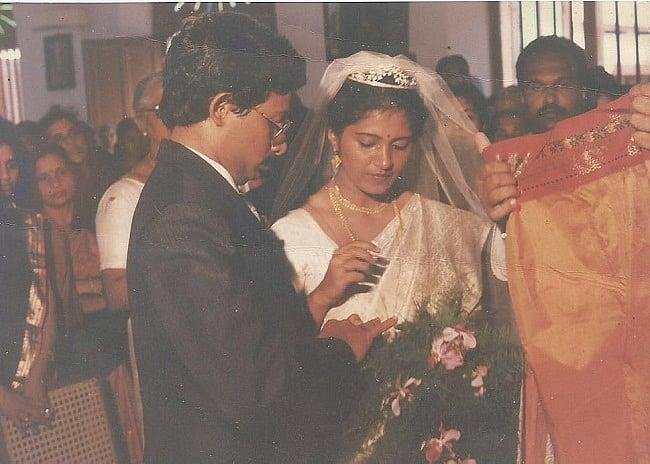
The heart of the Christian Sacrament of Marriage is the mutual covenant made by the bride and groom before the Church. They solemnly pledge to love one another faithfully and to nurture the children whom God may entrust to them. The tying of the thali (marriage pendant), the presentation of the manthrakodi (bridal veil), and the exchange of rings are visible symbols of this sacred covenant.
Traditionally, Knanaya couples knelt while the thali was tied. The priest then placed the manthrakodi on the lap of the kneeling bride. Today, however, the groom ceremonially places the manthrakodi over the bowed head of the bride, symbolically declaring his commitment to protect, honour, and care for his wife.
This custom has parallels in other ancient traditions. In Roman culture, the bride is ceremonially veiled during the wedding, while in the Greek tradition, the couple is crowned. Similarly, in Knanaya weddings, the bride receives the manthrakodi, followed by the ceremonial crowning with the traditional Venthan Mudi (royal crown).
A traditional Vattakkali wedding song beautifully describes this moment:
“Her hair is combed and neatly arranged;
The royal crowns are placed upon them, radiating splendour.”
Bar Mariyam Hymn and the Priestly Blessing
One of the distinctive features of a Knanaya wedding is the singing of the ancient Syriac hymn Bar Mariyam at the conclusion of the Nuptial Qurbana, followed by the blessing hymn Brukshe d’Alaha (“Blessings of God”). The senior priest or parish priest then blesses the newly married couple and the entire congregation.
The title Bar Mariyam, meaning “Son of Mary,” repeatedly appears throughout the hymn and proclaims the saving mission of Jesus Christ. The hymn reminds the faithful that the Christian family established through the Sacrament of Marriage forms an integral part of God’s plan of salvation fulfilled in Christ. Through this liturgical tradition, the Southist Knanaya community beautifully expresses its theological understanding that Christian marriage is not merely a social institution but a sacred vocation within God’s redemptive plan.
After the ceremony, the newly married couple jointly offers their thanksgiving offering at the church offertory box. They then visit the priest in the sacristy, greet him with “Eesho Mishihaikku Sthuthiyayirikkatte,” and express their gratitude for celebrating the sacrament.
Procession to the Groom’s House
Following the wedding ceremony, the bridal procession to the groom’s home was traditionally conducted with great festivity. The procession featured Panchavadyam (the traditional Kerala temple orchestra), Kurava (women’s ceremonial ululation), Nadavili (the traditional communal wedding chant), and the Thazhakkuda (ornamental ceremonial umbrella). In earlier times, the bride and groom were even carried in procession on elephants, reflecting the grandeur of the occasion.
Many of the seventy-two social privileges traditionally believed to have been granted to the Knanaya community by the Chera ruler Cheraman Perumal were prominently displayed during wedding ceremonies, making marriage celebrations an important expression of the community’s cultural identity.
Nadavili (The Ceremonial Wedding Chant)
One of the most distinctive customs of the Southist Knanaya wedding is Nadavili. Accompanied by the ceremonial Thazhakkuda, the newly married couple stand at the centre while the assembled men form a circle around them. Holding their breath, they loudly chant “Nada Nadayo… Nada… Nada… Nada…” three times in unison.
In the present practice, all participants gather around the couple. The groom’s maternal uncle first hands over the Thazhakkuda to the bride’s maternal uncle. Bowing their heads and pointing their hands toward the earth, the two maternal uncles jointly begin the chant by loudly proclaiming “Nada…” The participants then raise their hands toward the sky while sustaining the prolonged chant without taking another breath.
When they can no longer hold their breath, they wait for a signal from the maternal uncle, bend down together, point their index fingers toward the ground, and conclude with three powerful cries of “Nada… Nada… Nada…” This sequence constitutes one complete cycle of Nadavili and is repeated three times.
Traditionally, Nadavili is performed at three locations: in the church courtyard, midway during the journey to the groom’s house, and again upon reaching the family home. Depending on local custom, it may also be performed once or as many as five times.
Although Nadavili fundamentally expresses communal joy and celebration, it probably served several practical purposes in earlier times, when people travelled on foot over long distances and churches were few and far between. It likely relieved the fatigue of the journey, symbolically dispelled evil influences along the way, and announced to the family waiting at home that the wedding procession was approaching.
Kurava (Ceremonial Ululation)
Kurava, the rhythmic ululation performed collectively by women during joyful occasions, remains a familiar custom among several communities in Kerala. Historical records indicate that the privilege of performing Kurava, once reserved for royal women, was among the seventy-two honours granted by Cheraman Perumal to Knai Thoma.
This privilege is documented in Bishop Francis Ros’s report sent to Rome in 1604, now preserved in the British Museum Library, and also in Diogo do Couto’s Décadas da Ásia (1611). While European observers often remained silent regarding customs such as Nadavili, they paid particular attention to the ceremonial ululation of women, demonstrating how striking this practice appeared to foreign visitors.
Today, however, Kurava is generally no longer performed during Knanaya weddings.
Reception with Paddy and Holy Water (Nellum Neerum Vaikkal)
As the wedding procession reaches the decorated courtyard of the groom’s house, the bride and groom are traditionally welcomed by the groom’s mother through the ceremony known as Nellum Neerum Vaikkal (“Offering Paddy and Holy Water”).
The groom’s sister stands holding a lighted traditional lamp, a tray containing blessed holy water (Hannān water), paddy grains, and a blessed palm leaf from Palm Sunday. The groom’s mother dips the palm leaf into the holy water and traces the Sign of the Cross three times on the foreheads of the newly married couple before welcoming them into the house.
Paddy symbolizes prosperity and fertility, while the blessed water and palm leaf signify purification, divine blessing, and joy.
The ancient Marthomman Pattu refers to this ceremony in the verse:
“When paddy and holy water are offered, my heart is filled with joy.”
Here, the expression “Nellum Neerum Vaikkal” itself becomes synonymous with marriage.
The Synod of Diamper (Udayamperoor Synod) attempted to suppress this practice, declaring it improper and prescribing ecclesiastical penalties for those who observed it. Nevertheless, the Knanaya community steadfastly preserved the custom, demonstrating the extraordinary importance they attached to this ancestral tradition.
Vazhupiditham (The Mother’s Blessing)
Within the wedding pavilion, a raised ceremonial platform known as the Manarkolam is specially prepared for the bride and groom. Since it is elevated, the gathered community can clearly witness the ceremonies performed there.
Among the most moving rituals is Vazhupiditham. After obtaining the congregation’s permission three times, the bride’s mother stands before the couple. She places her right hand upon the groom’s head and her left hand upon the bride’s head, crossing her arms in the form of a cross, and offers a solemn prayer of blessing. During this moment, the assembled community sings the traditional Vazhuppattu (Blessing Hymn).
Through this blessing, the mother, representing both the parents and the gathered community, prays that the Holy Trinity may grant the couple long life, prosperity, many children, and a life lived according to God’s holy will.
The custom has profound biblical significance. In Genesis 48, Jacob crosses his hands while blessing Ephraim and Manasseh, placing his right hand upon Ephraim’s head. Likewise, during the Syro-Malabar Holy Qurbana, the priest crosses his hands while invoking the Holy Spirit upon the bread and wine. Thus, Vazhupiditham beautifully reflects both biblical tradition and Syriac liturgical symbolism.
Offering Milk and Banana
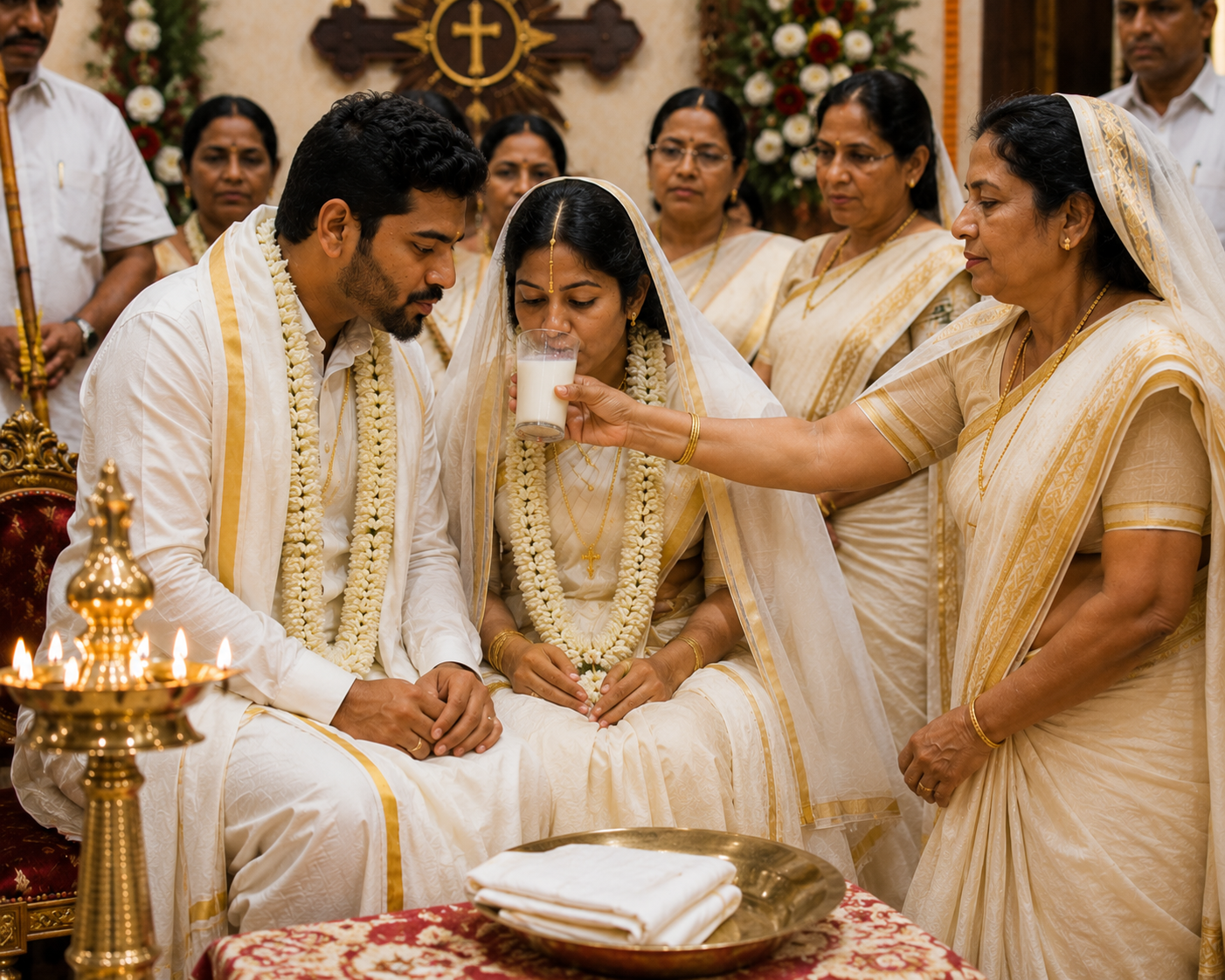
Seated together upon the Manarkolam, the newly married couple receive a glass of milk and a banana from the groom’s mother.
Sharing the same glass symbolizes the beginning of their united life as husband and wife. The ceremony expresses the prayer that their married life may always remain sweet, peaceful, and abundant.
The use of simple Kerala village foods such as milk and banana demonstrates the beautiful inculturation of Christian faith within local culture. Since these items have traditionally been offered as sacred gifts in Indian religious practice, they also symbolize purity, prosperity, and divine blessing.
Kacha Thazhukal (Ceremonial Embrace with the Gift Cloth)
During Kacha Thazhukal, the bride’s maternal uncle, mother, and maternal grandmother ceremonially embrace and bless the newly married couple. The ceremonial cloth presented to them by the groom’s family is called the Kacha.
These cloths are traditionally known as Achan Pathi, Amma Pathi, and Ammoomma Pathi, corresponding respectively to the maternal uncle, mother, and grandmother.
Wearing the traditional Njettum Vaalum headcloth, the bride’s maternal uncle asks the assembled community three times for permission, saying:
“May I perform the Kacha Thazhukal for the bridegroom and bride?”
He then gently strokes first the groom and then the bride three times along both sides of the thighs while blessing them. During this ritual, the couple presents him with a ceremonial cloth as a gift. The mother and grandmother subsequently repeat the blessing and receive their respective ceremonial gifts.
This custom recalls the biblical account in Genesis 24, where Abraham’s servant places his hand beneath Abraham’s thigh while taking an oath regarding Isaac’s marriage. It is also remembered in the ancient Knanaya migration song:
“They embraced one another with love before departing.”
Presentation of Wedding Gifts
While seated on the Manarkolam, the newly married couple traditionally receive gifts of gold ornaments such as necklaces, bangles, and rings from their relatives. Every close family member was expected to present a gift.
These gifts served not merely as expressions of affection but also as the financial foundation of the newly established household. In times of hardship, they could be sold or pledged, providing security for the family.
This practice reflects the cooperative spirit of the community, in which every relative actively participates in establishing the new household.
At the conclusion of the ceremonies, the wedding feast is served. The feast begins ceremonially when the groom’s maternal uncle pours water for the bride’s maternal uncle to wash his hands and serves him a specially prepared chicken leg. As in the traditional Othu Kalyanam (community wedding), this special dish is later shared with everyone gathered beneath the wedding pavilion, once again expressing the Southist Knanaya tradition of communal sharing and fellowship.
Handing Over the Bride (Kaipidichelppikkal)
After all the ceremonies in the wedding pavilion have been completed, the bride enters her husband’s home for the first time, stepping in with her right foot, a traditional sign of auspiciousness. She is welcomed by the groom’s sister, who stands at the entrance holding a lighted Nilavilakku (traditional oil lamp).
At this moment, one of the most touching ceremonies of the Knanaya wedding takes place—the Kaipidichelppikkal (“Handing Over the Bride”). The bride’s mother gently takes her daughter’s hand and places it in the hands of the groom’s mother.
Having lovingly nurtured and raised her daughter with prayer and care, the mother now entrusts the responsibility for her future well-being to the bridegroom’s mother. More than a formal transfer of responsibility, this ceremony represents the meeting of two mothers and the joining of two families through maternal love and trust. It remains one of the most emotional and meaningful moments in a Knanaya wedding.
Illappanam (The Clan Gift)
After the wedding, when the newly married couple prepares to visit the bride’s home, the groom’s father traditionally presents a monetary gift known as Illappanam to the bride.
This amount was intended to be spent on religious offerings, charitable works, and acts of generosity rather than for personal use.
According to ancient Knanaya traditions, the community was divided into seven clans (Illams): Baji, Belkooth, Hadhayi, Kujalik, Koja, Majamooth, and Thejamooth. Marriage within one’s own clan was traditionally prohibited. The term Illappanam is believed to have originated from the custom of giving a daughter from one clan to another in marriage. A comparable custom, in which the bridegroom’s family presents money to the bride’s family, is also found among the Jewish people.
Adachuthura (Closing and Opening the Bridal Chamber)
Traditionally, the newly married couple spent the first few days after the wedding at the bride’s home. This custom helped the young bride gradually adapt to married life before moving permanently into a completely unfamiliar household, especially during earlier centuries when child marriage was common.
On the third day after the wedding, the bride’s mother arrives at the groom’s house bringing sweets, household articles, and other gifts. The newly married couple, together with their companions, are then led into the bridal chamber (Manavara), after which the door is ceremonially closed.
Outside the room, family members sing the traditional Adachuthura Pattu (“Song of Closing and Opening”), describing the gifts that will be presented to the bridegroom.
A portion of the traditional song reads:
“O my beloved bridegroom, renowned among men,
I shall give you a bed and a mattress,
A lamp to light your home,
Fine silk garments and a beautiful canopy.
Whatever you desire, I shall gladly provide.
I shall give you everything in abundance.
O my dear son, bridegroom, open the door of the bridal chamber.”
The song expresses the family’s joyful promise to provide everything necessary for the couple to begin their new household.
When the bridal chamber is opened, the newly married couple and their companions come out amid the singing of the traditional Oil Song (Enna Pattu) and Bathing Song (Kulippattu). The couple is ceremonially anointed with oil, bathed, dressed in new garments, and seated in the wedding pavilion, where a festive meal is served.
Following the banquet, everyone gathers around the lighted Nilavilakku and sings traditional songs while participating in the ceremony known as Vilakku Thozhil (“Homage to the Lamp”). This concluding ritual symbolizes Christ, the Light of the World, guiding the newly established Christian family.
With this ceremony, the wedding celebrations formally come to an end.
Distinctive Features of Southist Knanaya Wedding Customs
The marriage customs of the Southist Knanaya community are remarkable in many respects. More than twenty-five individuals actively participate in conducting the various ceremonies, reflecting the deeply communal character of the wedding.
Particularly noteworthy is the significant role assigned to women and the special honour accorded to the bride’s family throughout the celebrations. Ceremonies such as the application of henna (Mailanchi), Nellum Neerum Vaikkal (Reception with Paddy and Holy Water), Offering Milk and Banana, Vazhupiditham (The Mother’s Blessing), and Kaipidichelppikkal (Handing Over the Bride) clearly illustrate the community’s deep respect for motherhood, family bonds, and the participation of women in preserving its cultural and spiritual heritage.
These customs beautifully combine biblical symbolism, Syriac Christian liturgical tradition, and the indigenous cultural heritage of Kerala. More than mere wedding rituals, they represent a living tradition through which the Southist Knanaya community has preserved its unique identity, faith, and values across generations.