Both the Portuguese translations of Francisco Ros and Diogo do Couto specify the place where the Knāyithomman Copper Plates were issued. Ros records that the charter was granted “in the great city of Mahādevar in Kerala,” while Do Couto similarly refers to “the city of Mahādevar in Kerala.” Mahādevar Pattinam, or Mahodayapuram, is generally identified with present-day Kodungallur. Ros’s translation also refers to “Cornelur” (possibly Kodungallur), where the Chera king was residing, and mentions the grant of “Magoder Pattinam” to Knāyithomman. Likewise, Do Couto’s translation distinguishes between “Cornelur,” the king’s residence, and the town called “Pattanam,” which was granted to Knāyithomman.
Although the exact location of the ancient port of Muziris (Muchiripattanam) has not been conclusively established, the ongoing excavations at Pattanam, near North Paravur, have produced evidence suggesting that Muziris was located a short distance from present-day Kodungallur. These archaeological findings should be considered alongside the conclusions of historians such as Dr. M. G. S. Narayanan, who argues that while Karur, near present-day Coimbatore, served as the principal capital of the early Cheras, a secondary royal centre also existed on the banks of the Periyar River, either at Muchiri (Muziris) or Vanchi. The second Chera capital, Makotai (Mahodayapuram), emerged only in the ninth century. It is reasonable to suggest that Knāyithomman and his merchant associates, by establishing a nagaram (merchant guild or commercial settlement), played an important role in the rise of Makotai as a major urban and commercial centre.
Compared with the suggestion that foreign merchants, whose names appear in three different scripts, witnessed the Tharisapalli Charter issued by a local ruler in a newly established commercial settlement at Kollam, it appears historically more convincing that such foreign witnesses were present at Muziris (Muchiripattanam, Muyirikkodu, Muchiri, present-day Kodungallur)—the Chera capital and one of the most celebrated international ports of the ancient world—where extensive overseas trade had flourished for centuries.
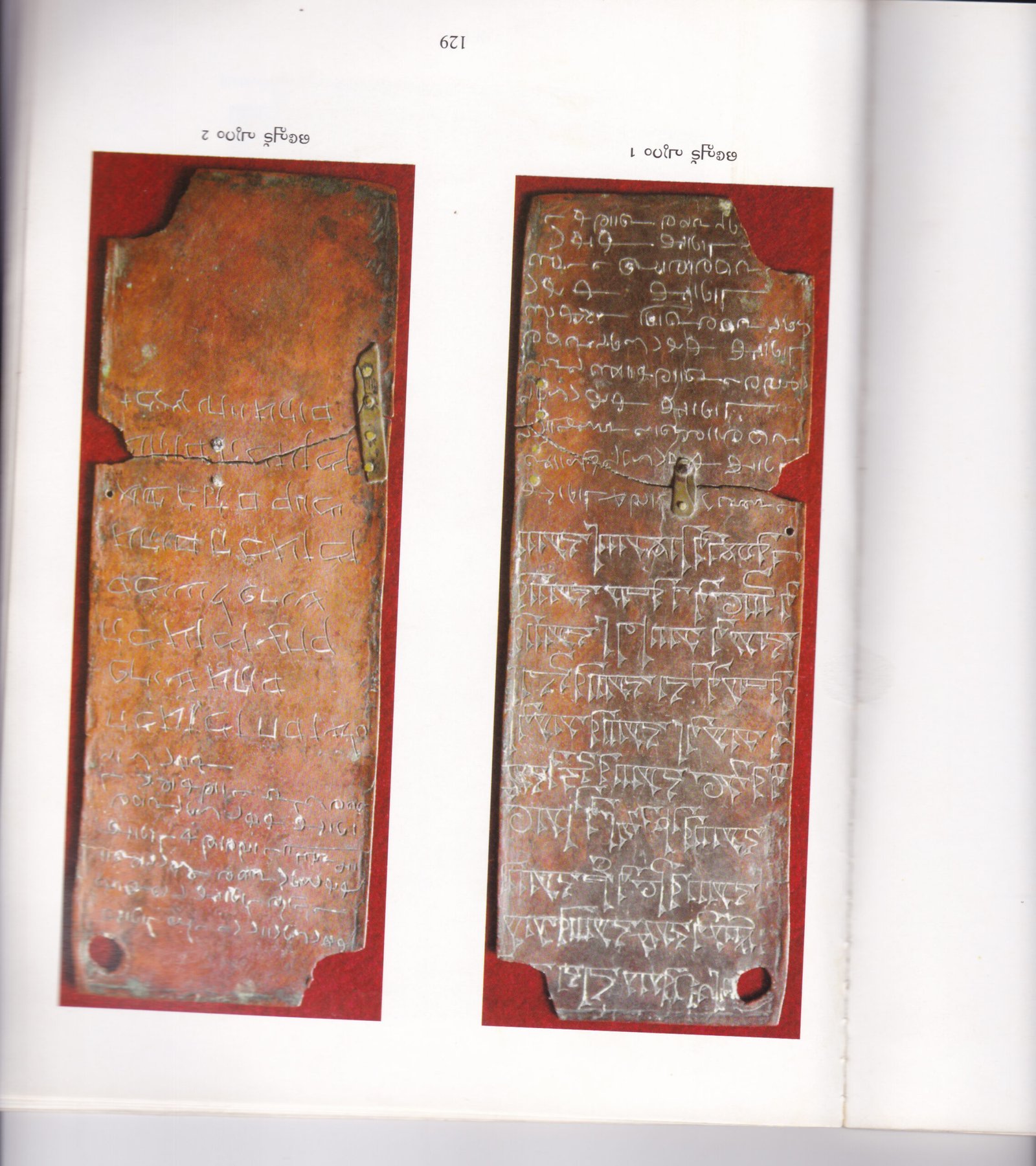
If the scripts used for the foreign witnesses on the witness plate indeed indicate the presence of Arabs, Persians, and Jews near the place where the charter was issued, then the continued existence of Arab, Persian, and Jewish communities in and around Kodungallur over many centuries—as reflected in monuments such as the Cheraman Juma Mosque and the historic Jewish synagogue—provides additional circumstantial support for identifying the witness plate as part of the Knāyithomman Copper Plates. By contrast, apart from the assumption that the witness plate belongs to the Tharisapalli Charter, there is relatively little independent evidence for a significant Arab or Jewish presence in Kollam during the relevant period.
The Curzon transcript introduces its summary of the Knāyithomman Copper Plates with the phrase: “This is the history of the establishment of the nagaram of Kodungallur.” This expression is strikingly parallel to the wording in the Tharisapalli Charter, which refers to “Maruvan Sapir Iso, who established this nagaram (at Kollam).” It is therefore worth considering whether the Knāyithomman charter originally referred to Knāyithomman as the Nasrani who established the nagaram of Kodungallur. In this context, the phrase should not necessarily be understood as meaning “the city of Kodungallur,” but rather the establishment of a merchant guild or commercial corporation at Kodungallur.
The Curzon summary also contains the expression “when Munampil Pattanam was a nagaram.” This suggests that the term nagaram was not used simply in the modern sense of “town” or “city,” but rather in a technical sense with a specific commercial or institutional meaning.
If nagaram is understood as denoting a commercial guild or mercantile corporation, then the phrase “the history of the establishment of the nagaram of Kodungallur” would signify the establishment of a commercial settlement or trading corporation at Kodungallur. This interpretation corresponds closely with the Tharisapalli Charter, which granted privileges for establishing a commercial centre at Kollam, and therefore explains why the Curzon transcript places the summary of the Knāyithomman Copper Plates immediately after the Tharisapalli Charter.
Geographical factors such as coastal erosion and the repeated flooding of the Periyar River may have necessitated the relocation of the nagaram from Munampil Pattanam, situated directly on the seashore, to a safer inland location. It is therefore possible that, after the arrival of Knāyithomman, the commercial settlement was re-established at the present-day Kottappuram, on slightly elevated ground near Kodungallur along the banks of the Periyar. This settlement may subsequently have become Makotai, Mahādevar Pattinam, or Mahodayapuram.
The Mahosa mentioned in ancient Syriac traditions may well refer to the same place. In modern Syriac, placing a dot beneath the letter Kaph (ܟ) changes its pronunciation to H, while a dot beneath Taw (ܬ) changes its pronunciation to S. Since ancient Syriac originally lacked these diacritical marks, the same letters could be pronounced either as K or H, and T or S, depending on context. Consequently, the place-name Makotai—which ends in -ai, a characteristic feature of Proto-Dravidian words such as yanai (“elephant”) and malai (“hill”), later becoming āna and mala in modern Malayalam—could naturally have been rendered by Syriac Christians as Mahosa.