Although the four extant plates of the Tharisapalli Charter do not directly refer to the Knāyithomman Copper Plates, as noted in previous articles, the Curzon copy of the Tharisapalli Charter and the French translation by Du Perron append a summary of the Knāyithomman Charter at the end of the fourth plate. This is a significant observation.
According to the reading presented by Dr. Jacob Kollaparambil at the Symposium on Knanites, two expressions found in the surviving Tharisapalli Charter deserve particular attention:
“Vārakkōluṅkappāṇum Veñcakkaṇḍiyum munnam peṟṟuṭaiyan ñānum viṭupeṟāka aṭṭikkuṭutten.”
and “Munnam paḷḷiyār peṟṟuṭaiya vārakkōlum pañcakkaṇḍiyum.”
The archaic Malayalam expression “munnam peṟṟuṭaiya” literally means “previously granted” or “already possessed by prior grant.” This naturally raises the question: What had been granted earlier, and by whom?
In his book The Sources of the Syro-Malabar Law, Fr. Jacob Kollaparambil suggests that these words refer to the privileges previously granted to Knāyithomman through the Knāyithomman Copper Plates issued by Cheraman Perumal. His reasoning is strengthened by the fact that a summary of the Knāyithomman Charter follows the Tharisapalli Charter in both the Curzon copy and Du Perron’s translation.
A similar observation appears in the work Tharisappalli Pattayam by Dr. M. R. Raghava Varier and Dr. Kesavan Veluthat, where they write:
“After the end of the fourth plate, Du Perron, relying on a Sanskrit translation available to him, provides the names of some local witnesses and a summary of a charter said to have been granted to Thomas of Cana. Is this what is referred to in the charter by the expression ‘munnam paḷḷiyār peṟṟuṭaiya vārakkōlum pañcakkaṇḍiyum’?”
This question is highly relevant.
The extant Tharisapalli Charter is not primarily concerned with the construction of the church. Instead, it grants lands and numerous privileges to the Tharisapalli, its members, and those associated with it. Therefore, one may reasonably ask whether the phrase “munnam peṟṟuṭaiya” refers to an earlier charter connected with the establishment of the church itself.
However, the opening section of the charter indicates that the land for the church had already been donated by Ayyanadikal and his council, in a meeting held without the presence of Vijayaragadeva, the representative of the Chera king. Consequently, if another charter had previously been issued concerning the construction of the church, it too would most likely have been granted by Ayyanadikal.
Yet the phrase “ñānum viṭupeṟāka aṭṭikkuṭutten” (“I too have confirmed/granted”) suggests otherwise. The word “ñānum” (“I too”) indicates that Ayyanadikal was not referring to privileges originally granted by himself, but rather to privileges previously conferred by someone else. This implies that the earlier grant must have been issued either by a predecessor in Venad or by another sovereign.
Since the summary of the Knāyithomman Charter is attached to the copies of the Tharisapalli Charter without any explanatory note, it is more reasonable to interpret these earlier privileges not merely as rights granted specifically to Mar Sabor Iso, but as privileges granted in a similar manner to Christian church communities.
The word “palli” in medieval Kerala was a general designation for non-Hindu places of worship. It referred to Buddhist, Jain, Christian, and later Islamic religious institutions—a usage that still survives in Kerala.
Local tradition consistently maintains that the Tharisapalli Charter was granted to Persian Syriac Christians. During the Portuguese period, the Tharisapalli continued to function as a Christian church. The revenues attached to the charter remained under the control of the Tharisapalli community until A.D. 1601. Following the construction of a new church and the ensuing legal dispute, the rights to these revenues were awarded to the Syriac Christian community that had relocated there. These facts firmly establish the Christian character of the Tharisapalli.
Likewise, the summary of the Knāyithomman Charter explicitly describes its recipient as:
“Knāyithommen, the foreign Nasrani.”
This clearly indicates that the defining identity of Knāyithomman was that of a Nasrani (Christian).
It is therefore reasonable to conclude that the Tharisapalli Charter issued by Ayyanadikal of Venad, in the presence of Vijayaragadeva, the representative of the Chera emperor, was supplemented by the summary of the Knāyithomman Charter in order to demonstrate that the same privileges earlier granted by the Chera emperor at Mahodayapuram (Kodungallur) to Knāyithomman, the Persian Christian merchant and church leader, were now being extended to Mar Sabor Iso, the Persian Christian and head of the Tharisapalli at Kollam.
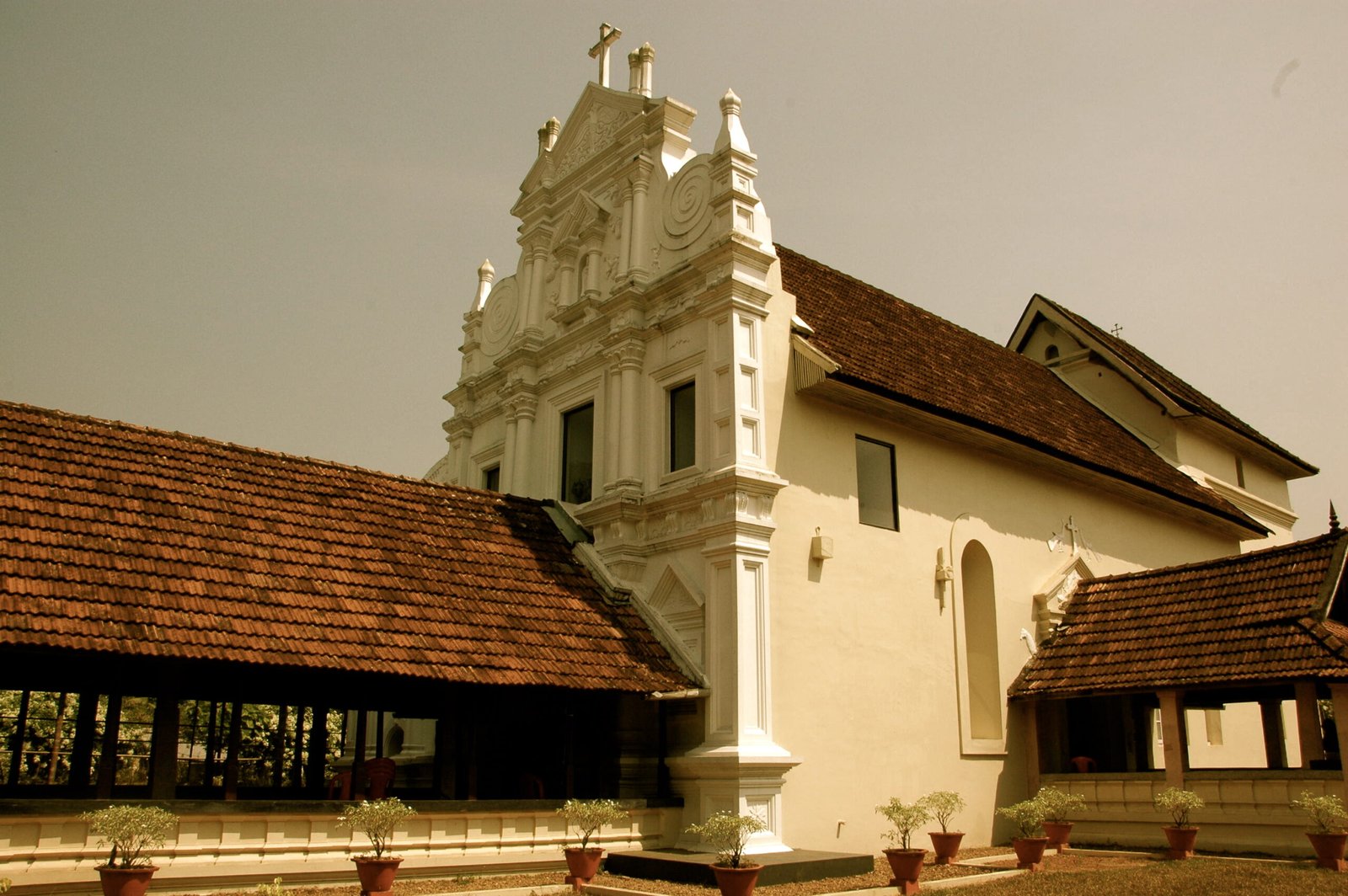
Although the church at Udayamperoor, belonging to the heirs of the Knāyithomman Charter, was dedicated to the Blessed Virgin Mary, the evidence of Gouvea’s Jornada suggests that until the Synod of Diamper (1599) it was also dedicated to Saint Mar Sapor and Saint Mar Proth. This strongly suggests an historical connection between these saints and the Knanaya community.
Another intriguing clue is the expression “Kolla Kodungallur” found in the Curzon copy. The term “Kolla” also appears in place names such as Kurakkeni Kollam, Pantalayani Kollam, and Kovalam, all of which have maritime associations. The name may therefore be connected either with a locality named Kolla within Kodungallur or with some historical relationship between Kurakkeni Kollam and Kodungallur. The precise nature of this connection remains to be determined.
To Which Copper Plate Does the Witness Plate Belong?
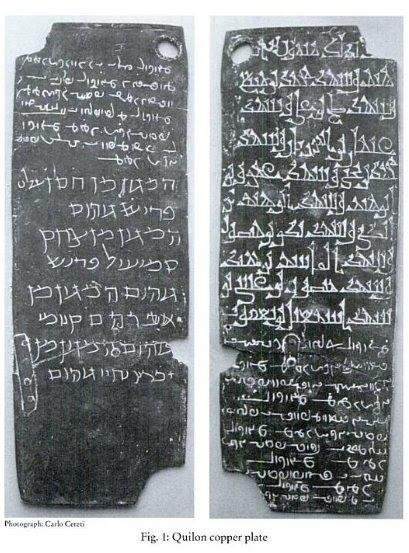
In the previous article, the possibility was advanced that the Witness Plate was not originally a part of the Tharisapalli Charter. If that is so, the obvious question is: To which charter did it originally belong?
Since the plate was discovered in Kerala, has been preserved there at least since 1806, and because copper-plate charters are a distinctive feature of the Indian epigraphic tradition, no serious claim has ever been made that it originated outside Kerala. The present investigation therefore focuses on whether it might have belonged to another Kerala copper-plate charter.
Most Kerala copper-plate charters concern temples, palaces, or similar institutions. In contrast, the Witness Plate contains the names of foreign witnesses written in multiple foreign scripts, making it unlikely that it belonged to any of those indigenous grants.Instead, attention turns to the four Kerala charters issued in connection with foreign merchants for the promotion of overseas trade:
- the Tharisapalli Charter,
- the Jewish Charter,
- the Iravi Korttan Copper Plate, and
- the Knāyithomman Copper Plate.
Since the Tharisapalli Charter has already been excluded from consideration, the remaining possibilities deserve examination.
The Jewish Charter, granted to the foreign Jewish merchant Parkkaran Iravi, initially attracts attention because four names on the Witness Plate are written in Hebrew script. Nevertheless, several considerations rule out this possibility.
Among the twenty-five witnesses listed on the Witness Plate, only four names are written in Hebrew characters. Even those Hebrew inscriptions represent Persian names. The remaining twenty-one names are written in Sasanian Pahlavi and Kufic Arabic scripts. Furthermore, the two surviving plates of the Jewish Charter have remained continuously in Jewish custody from the earliest period known to history until the present day. Like the Tharisapalli Charter, they are inscribed horizontally in Vattezhuthu. For these reasons, the Witness Plate cannot reasonably be regarded as belonging to the Jewish Charter.
Nor can it be associated with the Veeraraghava Pattayam, commonly known as the Iravi Korttan Copper Plate. That charter consists of a single plate, written horizontally in Vattezhuthu and Grantha scripts, with a noticeably greater use of Grantha characters. Its palaeography appears considerably later than the earlier charters, and modern historians generally date it to around A.D. 1225. It is also substantially larger than the Witness Plate. These characteristics effectively exclude any identification of the Witness Plate with the Iravi Korttan Charter.