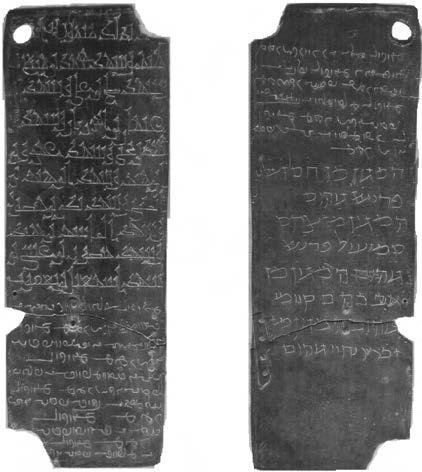
Among the six copper plates recovered in 1806, the so-called witness plate was later presented as part of the Tharisapalli Copper Plates. However, earlier records contain no indication that any copper plate other than the Knāyithomman Copper Plates was written in Arabic or Persian, or employed Kufic, Pahlavi, or Hebrew scripts. Consequently, the only plausible document to which the witness plate could belong is the Knāyithomman Copper Plates.
The strongest historical link between the witness plate and the Knāyithomman Copper Plates is found in the account of Pero de Sequeira, custodian of the Portuguese fortress at Cochin, as recorded by Damião de Góis in his 1566 biography of King Dom Manuel of Portugal.
According to this account, at the request of the Chaldean Bishop Mar Jacob (†1552), Pero de Sequeira redeemed the Knāyithomman Copper Plates by paying twenty cruzados. With a letter of recommendation from the King of Cochin, he then engaged a Jewish scholar in Cochin who was proficient in several ancient languages and scripts to read and transcribe the plates. A Portuguese translation was subsequently prepared and forwarded to King Dom Manuel, while the original copper plates remained preserved in the Cochin fortress until the completion of Sequeira’s term of office in 1556.
Damião de Góis states that these copper plates had originally been granted by Cheraman Perumal to St. Thomas the Apostle. As explained in an earlier discussion, this is most likely a scribal or editorial error. The contents of the document clearly indicate that the grant was made to Knāyithomman (Thomas of Cana). The substitution of St. Thomas for Knāyithomman may therefore have arisen through an error on the part of the Jewish translator, Pero de Sequeira, or Damião de Góis himself. Similar inaccuracies are evident elsewhere in the narrative, including the incorrect identification of the Portuguese Viceroy.
Sequeira’s description also provides important clues linking the witness plate with the Knāyithomman Copper Plates. He explicitly states that the document consisted of two copper plates, joined together at the top by a metal ring. The text was written in three languages—Arabic, Persian, and Malayalam (Malabar). Rather than being separated by language, words from these different languages were interwoven within the same text, so that the complete meaning of a sentence could only be understood by reading the multilingual expressions together.
The remarkable correspondence between Sequeira’s description and the linguistic and paleographic characteristics of the existing witness plate strengthens the possibility that the plate now regarded as an independent witness plate may, in fact, have originally constituted the second plate of the Knāyithomman Copper Plates.
If this is intended for an academic publication, I can also Produce a version with a more formal scholarly style, including footnotes and references.