Introduction
Bur Maryam is a Syriac hymn that bears witness to the Knanaya community’s fidelity to the way of Christ and to its enduring attachment to the liturgical and ecclesiastical heritage of the Chaldean Church. Composed in the Chaldean Syriac language, the hymn opens with the words Bur Maryam, meaning “Son of Mary” (Jesus).
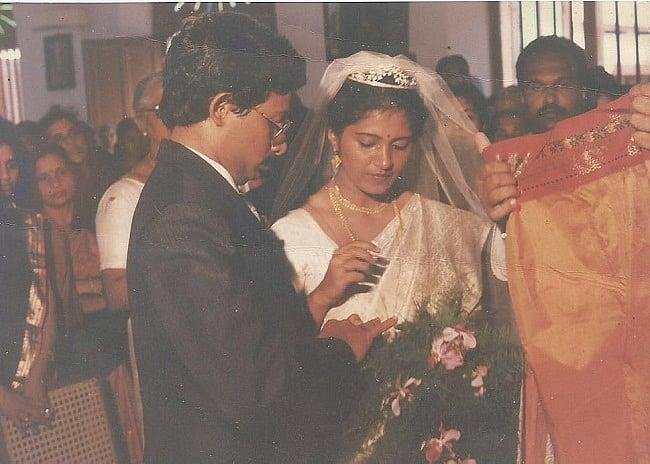
As an integral part of the Knanaya marriage tradition, this hymn is sung at the conclusion of the Church’s marriage rite by the clergy and the faithful, who sing in two alternating choirs. Following its rendition, the celebrant blesses the newly married couple and sanctifies them by sprinkling them with the blessed Hannān water.
The Bur Maryam hymn, used in this ceremony, occupies a cherished place in the heart of the Knanaya community because of its profound theological richness and historical significance. Although it is neither a prayer addressed to the Blessed Virgin Mary nor a formal prayer of blessing, it presents a concise yet comprehensive proclamation of the Christian faith. The hymn reflects and enriches several major branches of Christian theology, including Trinitarian theology, Christology, Pneumatology, Mariology, Ecclesiology, Sacramental Theology, and Theological Anthropology. Thus, it stands as a remarkable theological summary preserved within the liturgical heritage of the Knanaya community.
Sources
1. A Sixteenth-Century Chaldean Manuscript
Mr. Wilson Muriyadan, a native of Thrissur, a member of the Chaldean Syriac Church of the East (Surayi), and a scholar devoted to Syriac studies and manuscript preservation, has indicated that a sixteenth-century manuscript containing the Bur Maryam hymn has been identified among the archival records of the Chaldean Church in the Middle East. His detailed study and the accompanying documentary evidence are expected to be published in the near future. If these findings become available, they would constitute compelling evidence that the Bur Maryam hymn had long been in use within the Chaldean Syriac Church of Babylon.
2. The Ksāwā d-Ṣlāwūsā (1886–1887)
The Bur Maryam hymn appears in Syriac script in the three-volume Chaldean/Babylonian Syriac breviary, Ksāwā d-Ṣlāwūsā, published in Paris in 1886–1887 by Fr. Paul Bedjan. It is included in the third volume, which contains the hymns and prayers required for the celebration of the Holy Qurbana. The hymn is arranged under two liturgical seasons: Elda (the Season of the Nativity) and Denha (the Season of the Epiphany). Excluding the refrain, “Bur Maryam, Bur Maryam, Bar Alāhā d-Yeldath Maryam” (“Son of Mary, Son of Mary, Son of God born of Mary”), the hymn consists of eighteen couplets.
Fr. Paul Bedjan (1846–1920) was born at Khosrowa in Persia (present-day Iran) into an Assyrian Chaldean Catholic family. He later entered the Lazarist Congregation and pursued higher studies in France before being ordained a priest. After returning to his homeland, he engaged in missionary work. Subsequently, he spent the remainder of his life in various European countries, including France, Belgium, Germany, and Italy.
Bedjan devoted himself primarily to Syriac scholarship. His principal work consisted of composing original Syriac texts, translating both into and from Syriac, and editing and publishing Syriac manuscripts preserved in the libraries and archives of Rome. Among his best-known publications are the Acts of the Martyrs and Saints, the Life of Mar Yahballaha, George Bar Hebraeus’ Nomocanon, and the Selected Homilies of Jacob of Serugh. His editions remain among the most valuable contributions to the study and preservation of the Syriac literary tradition.
3Ancient Songs of the Syriac Christians of Malabar (1910)
The first printed edition of Ancient Songs of the Syriac Christians of Malabar, published in 1910, includes the Bur Maryam hymn under the title “The Hymn Bur Maryam” on page 23, immediately following the opening article entitled “Marriage Customs of the Southist Syriac Christians.” The following explanatory note accompanies the text:
“The hymn ‘Bur Maryam’ is a Syriac hymn that has been sung from ancient times by the clergy and the choir at the conclusion of the marriage rites during the wedding celebrations of the Southist Syriac Catholics. In the Babylonian Chaldean Syriac liturgical tradition, it belongs to the liturgical offices of the Nativity and Denha (Epiphany) and contains a concise history of the Incarnation of the Son of God.“
Earlier, on page 8 of the same introductory article, another important observation is made:
“Formerly, both the marriage blessing and the hymn Bur Maryam were performed immediately after the marriage ceremony itself. However, for the past twenty-five years these rites have been celebrated during the Holy Qurbana.“
Excluding the refrain, “Bur Maryam, Bur Maryam, Bar Alāhā d-Yeldath Maryam,” and the concluding line, “L’ālam Ālmīn Bur Maryam, Āmēn wa Āmēn Bur Maryam,” the version published in this collection consists of twenty-three couplets comprising forty-nine lines written in Malayalam script. This is the earliest known publication of the Bur Maryam hymn in Kerala and the first appearance of the hymn in the Malayalam script.
Significantly, this version contains five additional couplets at the end that are absent from the text published by Fr. Paul Bedjan. This suggests that the Knanaya community did not derive its version directly from Bedjan’s edition but rather preserved the hymn from another, much older textual tradition.
Furthermore, the statement that the marriage blessing and the Bur Maryam hymn had been transferred to the celebration of the Holy Qurbana only “during the past twenty-five years” allows us to infer that the hymn was already being sung at Knanaya weddings before 1885, predating Bedjan’s publication of 1886–1887. Moreover, the footnote explicitly states that the hymn had been sung “from ancient times” during the marriage celebrations of the Southist Syriac Catholics, providing additional evidence for its long-standing use within the community.
It is particularly noteworthy that the editor specifically identifies the hymn as belonging to the marriage celebrations of the Southist Syriac Catholics. This indicates that the Knanaya community regarded Bur Maryam not merely as an ordinary liturgical hymn but as an integral component of its distinctive marriage tradition. At the same time, P. U. Lucas remains silent regarding its use by other Syriac Christian communities outside the context of marriage. By stating that it was sung exclusively by the Catholic Southists during wedding ceremonies, he also implicitly suggests that it was not used by the Knanaya Jacobites—a point that is clarified more explicitly in the second edition of Ancient Songs.
The editor’s further observation that the hymn belongs to the Babylonian Chaldean Syriac liturgy for the seasons of the Nativity and Denha and contains a concise account of the Incarnation clearly demonstrates that the first editors of Ancient Songs—P. U. Lucas and Fr. Mathai Vattakkalathil—possessed an accurate understanding of both the origin and the theological content of the Bur Maryam hymn.
4. The Second Edition of Ancient Songs (1935)
The second edition of Ancient Songs, published in 1935, contains an introductory article entitled “A Brief Description and Explanation of the Knanaya Marriage Ceremony.” Unlike the first edition, however, this article makes no reference to the Bur Maryam hymn. The likely reason is that the editors had already provided a lengthy explanatory note accompanying the hymn itself on pages 19–20 under the title “The Hymn Bur Maryam.”
The note explains that Bur Maryam belongs to the Babylonian Chaldean Syriac liturgy for the seasons of the Nativity and Denha and presents a concise account of the Incarnation of Christ. It further states that, from ancient times, the hymn had been sung by the clergy and choir at the conclusion of the marriage rites among the Knanaya Syriac Christians of Malabar.
The editors then provide a historical explanation for the disappearance of the hymn from the Jacobite branch of the Knanaya community. According to the note, following the Coonan Cross Oath (1652–1653), a section of the Malankara Syriac Christians separated from the Mother Church. In 1653 they consecrated Mar Thoma I in Alangad through the laying on of hands by twelve priests, and until the time of the sixth Mar Thoma (1772), they continued to celebrate their liturgy according to the ancient Chaldean rite. Subsequently, Mar Gregorios, sent by the Jacobite Patriarch of Antioch, regularized the episcopal office of the sixth Mar Thoma, who assumed the name Mar Dionysius. From that period onward, the Antiochene Syriac rite and Jacobite ecclesiastical tradition, previously unknown in Malankara, gradually replaced the older Chaldean liturgical tradition.
Since a section of the Knanaya Syriac Christians joined this movement, they likewise abandoned the ancient Chaldean rite that their forefathers had preserved from the time of their migration to Malabar in A.D. 345. Consequently, the Chaldean liturgical hymn Bur Maryam gradually disappeared from among them.
The editors also emphasize that this hymn was never generally practised among all Chaldean Syriac Catholics in Malabar. Apart from a few distinctive customs—such as the Bur Maryam ceremony, the rite of joining hands during marriage, and the post-funeral embrace—virtually all other liturgical practices were shared by both the St. Thomas Nazrani Catholics and the Knanaya Syriac Catholics.
They conclude by observing that Bur Maryam, a hymn found exclusively in the Babylonian Chaldean Syriac liturgical tradition and still preserved by the Knanaya Chaldean Syriac Catholics as a distinctive communal marriage rite, continues to serve as a visible expression of their enduring bond with their ancestors, their ancestral homeland, and their original liturgical heritage. Its continued observance stands as a lasting testimony to their historical memory, reverence, and fidelity to their inherited ecclesiastical tradition.