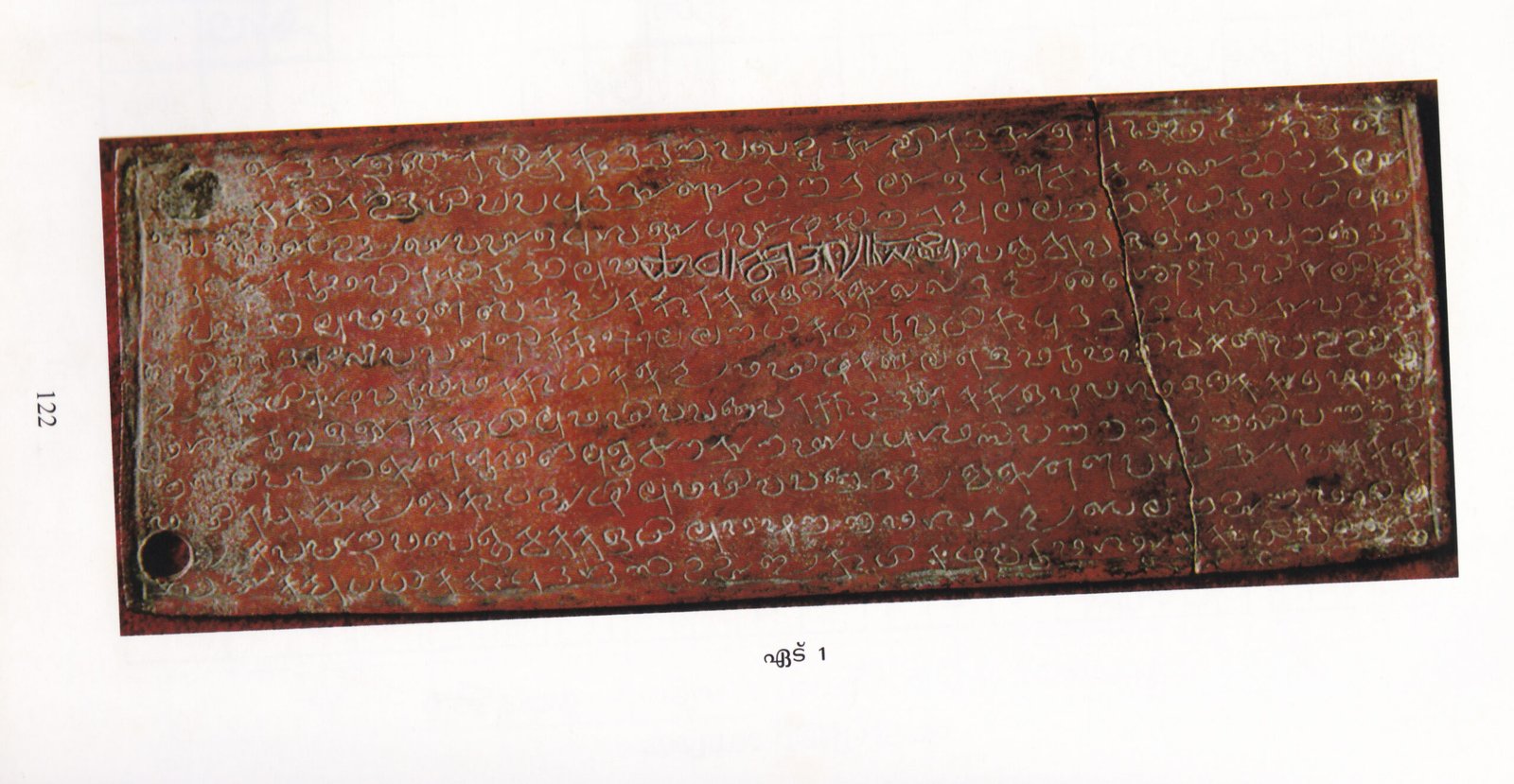
If the Knāyithomman Copper Plates were indeed issued around A.D. 345, the traditional date assigned to the Knanaya migration, an important question must be addressed: Were the scripts found on the witness plate—Kufic Arabic, Sasanian Pahlavi, Hebrew, and Vattezhuthu—in existence during that period?
The script known as Kufic Arabic, which later became famous as the script of the Qur’an (7th century), is understood to have evolved from an earlier script known as Tabālthān (or one of the pre-Islamic North Arabian scripts). Since this parent script had already fallen out of use by the fourth century, it is reasonable to infer that the early forms of Kufic must have developed before then. Likewise, Sasanian Pahlavi was the official script of the Sasanian Empire in Persia and had been in use since approximately the second century B.C. The Hebrew script, in which the books of the Old Testament were written, was naturally well established long before the fourth century. A detailed palaeographical analysis of these three scripts on the witness plate may therefore help determine its date with greater precision.
Even if the period of the inscription is established with greater certainty, one should not conclude that a fourth-century inscription could not have been written in Vattezhuthu merely because no Vattezhuthu inscriptions earlier than the ninth century have yet been discovered in Kerala. The absence of surviving inscriptions before the ninth century does not prove that the script itself did not exist; it merely indicates that earlier examples have not yet been found. Since the Tharisapalli Copper Plates, generally dated to A.D. 849, employ Vattezhuthu extensively and in a highly developed form over seven inscribed surfaces, it is reasonable to conclude that the script must have originated and evolved several centuries earlier.
Writing Orientation and the Position of the Ring Hole
Although Kerala inscriptions were generally engraved with the copper plates held horizontally, a remark by Pero de Sequeira suggests that the first plate of the Knāyithomman Copper Plates, like the present witness plate, may have been written vertically.
While describing the two copper plates as being joined together by a thick copper ring, Sequeira uses the Portuguese expression referring to the ring being attached at the “top.” Although this word commonly means “upper,” its more precise meaning is “the highest point” or “summit.” This description corresponds more naturally to a plate held vertically than to one held horizontally. If this interpretation is correct, both plates of the Knāyithomman charter were probably engraved in a vertical orientation.
Like the witness plate, a vertically engraved plate would ordinarily have the same upper edge on both sides. Accordingly, if the first plate also had its ring hole on the upper left corner of the obverse, matching the witness plate, Sequeira’s description would fit remarkably well.
Separation of the Two Plates
How the two copper plates became separated from the original ring remains one of the unresolved questions of this investigation.
One possibility is that the first plate, written in the Malabar language, could be read locally, whereas the second plate, containing inscriptions in Semitic scripts, was detached and entrusted to a Jewish scholar for interpretation. Another possibility is that both plates were initially examined together by the Jewish reader. After it became apparent that the second plate contained little more than the names of witnesses, it may have been considered of little practical value and left behind in India, while the first plate was taken to Portugal.
Comparable editorial practices can be observed elsewhere. In the Curzon transcript, the names of all the witnesses in the Tharisapalli Charter are omitted. Likewise, in Diogo do Couto’s Portuguese translation of the Knāyithomman Copper Plates, only a few Kerala witnesses are named before he remarks that the remainder have been omitted to avoid excessive length.
In this context, the suggestion made by Fr. Jacob Kollaparambil that the missing first plate may still survive in a Franciscan monastery in Lisbon, where the Franciscan missionaries are believed to have deposited it, deserves serious consideration.
The history of the witness plate after its separation from the first plate until its rediscovery in 1806 remains completely unknown. Although Sequeira states that the copper plates were preserved in the Portuguese fortress at Cochin, no evidence has yet been found that the witness plate remained there. Neither Archbishop Francisco Ros, Gouvea, nor Diogo do Couto, all of whom record the loss of the Knāyithomman Copper Plates, make any separate reference to the witness plate. Nor was it located by the Dutch, including Adriaan Moens, or later by the British before 1806.
It is therefore possible that, for reasons now unknown, the witness plate eventually came into the possession of the Tharakan family of Thevalakkara. Another possibility is that the four plates of the Tharisapalli Charter were preserved in the Tharakan household, while the witness plate and the Vīrarāghava Pattayam remained elsewhere, perhaps in the Cochin fortress or another repository, until Colonel Colin Macaulay recovered them in 1806.